

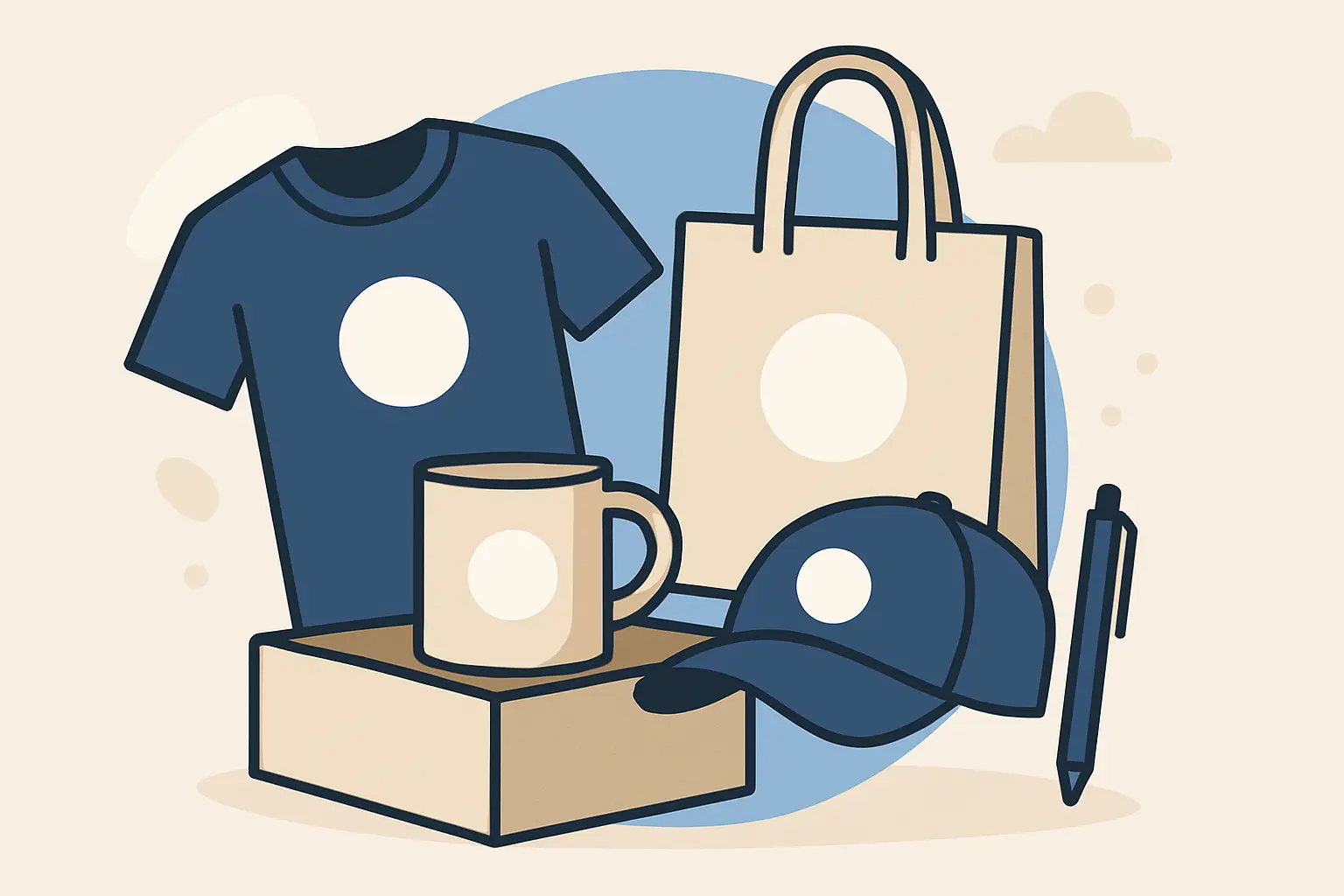
Someone keeps your logo water bottle on their desk for eight months. Another person wears your hoodie to three different weekend events. A third throws your cheap pen away before they get back to the car.
That is the quiet truth about promotional products and custom merchandise: they are not “stuff.” They are repeated brand impressions that either build trust over time or quietly erode it. For small and midsize businesses – and for government organizations that need consistency, clarity, and responsible spending – the difference comes down to strategy, fit, and execution.
Why promotional products and custom merchandise still win attention
Digital marketing is fast and measurable, but it is also crowded. A physical item changes the dynamic. It slows the moment down. It creates a tiny relationship between your brand and the person holding it.
The best items do three things at once. They solve a small, real problem (hydration, charging a phone, taking notes, staying warm). They feel like they came from a thoughtful organization. And they show your brand consistently – not just your logo, but your colors, your tone, and the way you want people to talk about you.
There is also a practical advantage that often gets missed: a good piece of merch can reinforce a broader initiative. If you are launching a new service line, hosting a recruiting push, rolling out a safety program, or rebuilding community trust, the right item becomes a physical reminder that the message is active and ongoing.
The real goal: brand memory and brand behavior
A lot of people approach merchandise with one question: “What is the cheapest thing we can put our logo on?” That is a budget conversation, not a brand conversation.
A stronger question is: “What do we want someone to do or believe after they interact with us?” Sometimes the goal is awareness, but often it is more specific – sign up, show up, refer a colleague, feel confident choosing you, or remember you when a contract is up for renewal.
Promotional items can support those goals, but only if the item and the moment match.
For example, if your objective is lead generation at an event, you want an item that earns a follow-up conversation or makes it easy to reconnect later. If your objective is client retention, you want something that lives where the client works and subtly reinforces reliability. If your objective is internal alignment, you want merchandise that employees actually enjoy using so the brand feels real, not forced.
Choosing merch that fits your audience (and your reality)
The “best” item depends on who you serve, how they work, and what kind of organization you are. That is why a one-size-fits-all list of top products rarely helps.
Start with context. Where will this item be used? A commuter tumbler is great if your audience drives or rides transit. A desk item is ideal if they spend their day at a workstation. An outdoor piece makes sense for field staff, parks departments, job sites, and community events.
Then consider what people already carry. If your clients are constantly mobile, compact and durable wins. If they are in meetings all day, something that looks polished in a conference room matters. If you serve the public, you may need items that feel inclusive and universally useful, not niche.
Finally, be honest about your brand. If your organization positions itself as premium, safety-focused, or detail-oriented, the merch has to back that up. A flimsy item with fading print sends the opposite message – even if your services are excellent.
Quality is not about luxury – it is about trust
Quality is a loaded word because it sounds expensive. In practice, quality just means the item performs the job it promises to do.
A mug that leaks, an umbrella that breaks, or apparel with itchy seams does not simply disappoint. It creates a story, and the story is about your organization. People may not remember your tagline, but they will remember that the zipper failed.
That does not mean every project needs top-tier materials. It means you should be intentional about where quality matters most. Items with daily use – drinkware, bags, outerwear, tech accessories – deserve more attention because they generate more impressions and stronger emotional reactions.
There is also a sustainability trade-off worth considering. Sometimes the greener option is not the “recycled” label – it is choosing fewer items that last longer. If an item sticks around for years, that is less waste and better brand value.
Branding details that separate “nice” from “forgettable”
Design is where promotional products become custom merchandise, and it is also where many projects stumble.
Logo placement should feel balanced, not like a stamp. Color accuracy matters more than many teams expect, especially for organizations that have multiple departments or locations. A navy that shifts to purple across different items can make a brand look disorganized, even if everything technically uses the same logo.
Think beyond the front-and-center mark. A subtle sleeve print on a hoodie, a tone-on-tone imprint on a notebook, or an interior message on packaging can feel more premium and more human. For public sector teams, clarity and readability often matter more than cleverness – clean marks, high contrast, and consistent application.
Also consider what the product communicates before anyone reads the logo. A clean, modern item suggests competence. A cluttered design suggests noise. Sometimes less branding creates more pride in using the item, which ironically increases how often your brand gets seen.
Timing and distribution: the part that makes the ROI real
Even a great product falls flat if it shows up at the wrong time or never reaches the right hands.
If you are planning for an event, lead time matters. That includes proof approvals, production, shipping, and a buffer for surprises. For ongoing programs – onboarding, volunteer appreciation, annual trainings – the best approach is often to set a simple merchandise calendar so you are not reinventing the wheel every quarter.
Distribution deserves a plan, too. Are you handing items out at check-in? Mailing them to remote employees? Including them in proposal kits? Keeping a small inventory for last-minute VIP visits? These choices affect what items make sense and how much you should order.
For many organizations, a hybrid approach works well: a core set of evergreen items you can reorder, plus a smaller run tied to a specific campaign or season.
How to measure success without overcomplicating it
Merchandise measurement does not have to be perfect to be useful. You just need a few signals.
If the merch is tied to an event, track whether it increased booth traffic or conversations. If it is tied to a campaign, use a simple unique URL, QR code, or dedicated phone extension to see if people follow through. If it is internal, look at adoption – are employees actually wearing it, asking for another size, or using it on video calls?
You can also measure indirectly through outcomes you already track: improved retention, higher satisfaction, increased referrals, better recruiting flow. Promotional products rarely cause those results alone, but they can reinforce the message that gets people over the line.
The most important measurement is often qualitative. What do people say when they receive it? Do they smile, comment on quality, or immediately put it to use? That moment is a brand health check.
Common pitfalls (and how to avoid them)
The biggest pitfall is treating merch as an afterthought. When it is rushed, teams pick generic items, approve proofs quickly, and hope it works out. Sometimes it does. Often it does not.
Another common issue is inconsistency across departments. One team orders shirts with an outdated logo. Another uses a different shade of blue. A third picks a totally different tone of messaging. The organization starts to look fragmented.
There is also the “warehouse problem”: ordering too much of a product that seemed like a good idea but does not move. The fix is not to avoid merchandise. It is to choose items with clear use cases, order in smarter quantities, and build a repeatable process.
This is where a holistic brand partner can help connect the dots between your brand standards, your campaign goals, and the practical realities of procurement and fulfillment. Teams that already rely on OneStop Northwest LLC often find that merchandise becomes easier once it is treated as part of the broader brand system – not a one-off purchase.
Making it all work together
The strongest promotional products and custom merchandise programs feel coordinated. Your website, social presence, printed materials, email signatures, and physical items all tell the same story. When that happens, the merch is not just advertising. It is proof of consistency.
If you are a business competing in a crowded market, that consistency reduces friction – prospects feel like they know you sooner. If you are a government organization, it builds credibility – the public sees professionalism and care in the details.
When you are deciding what to order next, keep one principle in mind: give people something they will genuinely keep. Not because you want more impressions, but because the item earns its place in their day. If you can do that, the branding becomes a natural byproduct of usefulness – and that is where the real momentum comes from.