

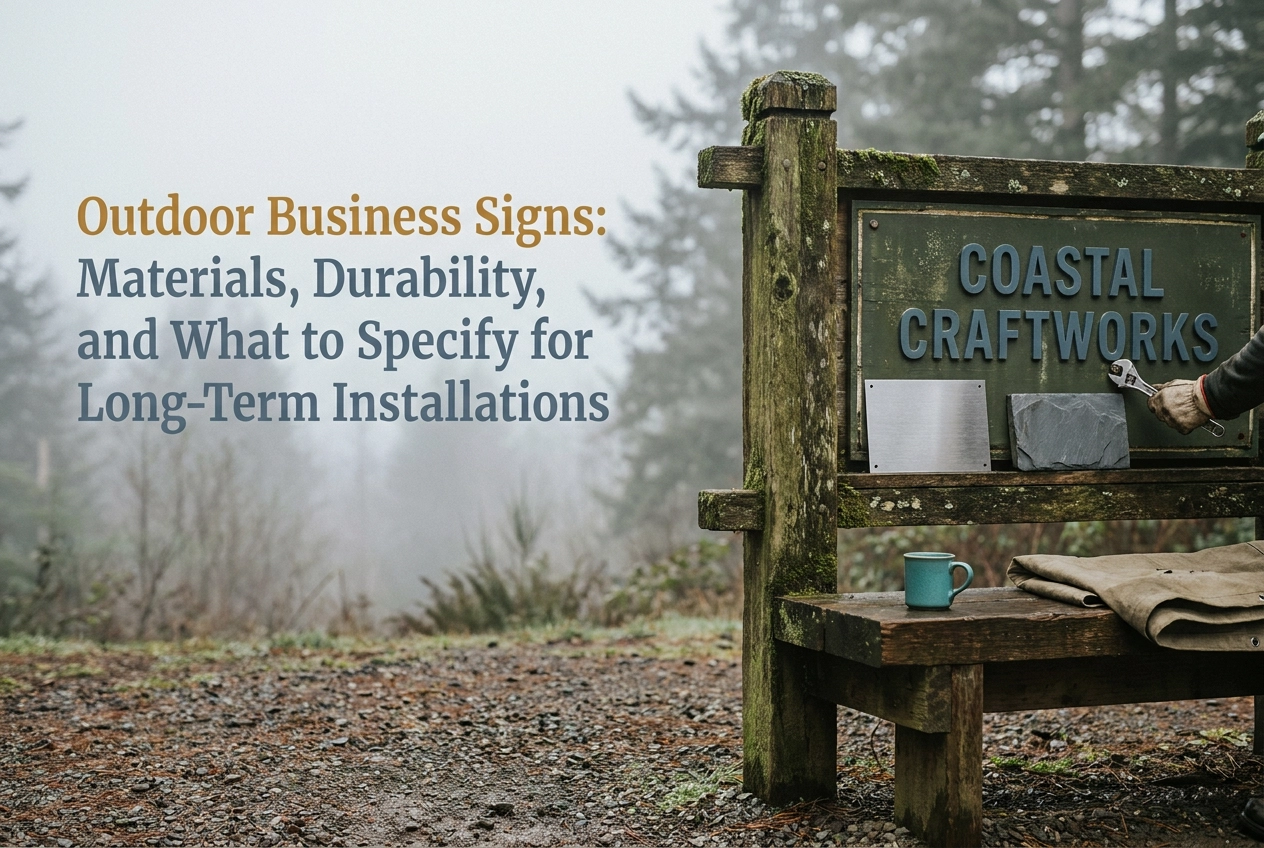
Sixty-five percent of outdoor signs installed in Florida require replacement within two years when materials are not matched to local climate conditions. That statistic is not an anomaly; it is the predictable result of specifying on price rather than performance. For facilities managers and marketing buyers responsible for long-term installations, the difference between a sign that lasts a decade and one that fades, warps, or fails structurally within the first few years comes down to decisions made before the fabrication order is placed.
This analysis covers everything you need to specify outdoor business signs with confidence. You will find detailed comparisons of metal substrates including aluminum, stainless steel, and Corten, alongside acrylic, LED, wood, and PVC alternatives. The guide addresses how climate zones should drive material selection, which mounting methods protect structural integrity over time, and how to calculate total cost of ownership rather than upfront cost alone. A practical specification checklist closes the technical sections so you leave with a working framework, not just background knowledge. If you are responsible for a sign installation that needs to perform for five years or more, the material decisions outlined here are where that outcome is won or lost.
Why Material Selection Is the Most Important Decision You Will Make
Sixty-five percent of outdoor signs installed in Florida require replacement within two years when materials are not matched to local climate conditions. That is not a maintenance statistic; it is a procurement failure that repeats itself every budget cycle when buyers treat substrate selection as an afterthought.
Climate is the primary determinant of which material survives a 10-to-15-year horizon, not aesthetics. UV intensity, ambient humidity, freeze-thaw cycling, salt spray proximity, and thermal expansion rates all degrade substrates at different rates and through different mechanisms. A sign that looks appropriate for a location may be structurally incompatible with it. Getting that wrong is expensive in ways that don’t show up until year two or three, when fading, delamination, or fastener corrosion forces an unplanned replacement.
The buyers who recover their signage investment are the ones who treat it as a capital purchase. A durable, correctly specified sign installed once at a higher upfront cost consistently outperforms a cheaper sign replaced twice over the same period, on total cost, on administrative time, and on brand consistency.
Premature failures follow a recognizable pattern. Signs that fail early almost always do so within the first five years, and the cause traces back to decisions made on price rather than performance: the wrong substrate for the humidity level, a coating not rated for UV exposure, or zinc-plated fasteners on an aluminum substrate generating galvanic corrosion at the mount points. These are specification errors, not manufacturing defects.
Site variability compounds the challenge for multi-location organizations. A powder-coated aluminum panel that performs reliably at a Pacific Northwest location for 15 years may show surface degradation at a Gulf Coast location within 18 months under the same specification. Climate zone, not brand standard, governs material selection, and organizations with properties across multiple regions need location-specific specifications rather than a single national template.
Custom Metal Signs: Aluminum, Stainless Steel, and Corten Compared
Metal is the default substrate for long-duration outdoor sign installations, and for good reason. Within that category, aluminum, stainless steel, and Corten each serve a distinct set of conditions.
Aluminum is the most widely used outdoor sign material across commercial applications. Properly powder-coated or painted, it resists corrosion, handles wind load without deflection, and delivers a realistic service life of 15 to 20 years in temperate climates. Its weight advantage over steel simplifies both fabrication and wall-mounting, and it accepts virtually any finish system.
Fabrication method affects longevity as much as alloy selection. Laser-cut and router-cut aluminum dimensional letters produce clean, sealed paint edges that hold up under UV exposure. Stamped forms leave micro-fractures along cut edges where paint adhesion is weaker, and edge fade from those points typically becomes visible within the first two years of sun exposure.
Stainless steel carries a higher upfront cost, but that premium is justified in coastal, industrial, or high-traffic environments where aluminum is more vulnerable. Marine-grade stainless resists salt spray, airborne pollutants, and physical impact in ways that aluminum cannot match, and its service life extends to 15 years or more even in demanding conditions. For organizations operating near saltwater, including much of the Pacific Northwest coastline, stainless is frequently the better long-term value when total cost of ownership is compared across a full installation cycle.
Corten, or weathering steel, is a specialist choice. It forms a stable oxide patina that acts as its own corrosion barrier, eliminating the need for paint in most exterior environments. That patina is also a deliberate aesthetic: the warm rust tone reads as architecturally intentional and suits monument bases, campus wayfinding, and exterior brand installations where a raw, industrial character aligns with the brand identity.
One specification detail that consistently causes early failures is fastener mismatch. Zinc-plated hardware against stainless or aluminum substrates creates a galvanic reaction at contact points, accelerating localized corrosion that compromises the mounting system independently of how well the sign face itself holds up. Matching fastener metal to substrate metal resolves this entirely and costs nothing extra to specify upfront.
Custom metal signs as a category perform best in applications that demand structural rigidity: monument bases, building-mounted identification, parking and wayfinding systems, and any installation where wind load, physical contact, or long unattended service intervals are part of the operating reality.
Custom Acrylic Signs: Design Flexibility With Conditions
Where metal substrates are the right answer for structural rigidity and long service life, acrylic earns its place in applications that demand something metals cannot deliver: optical clarity, vibrant color transmission through backlighting, and the design freedom to produce illuminated channel letters, dimensional logos, and backlit cabinet faces that genuinely draw attention.
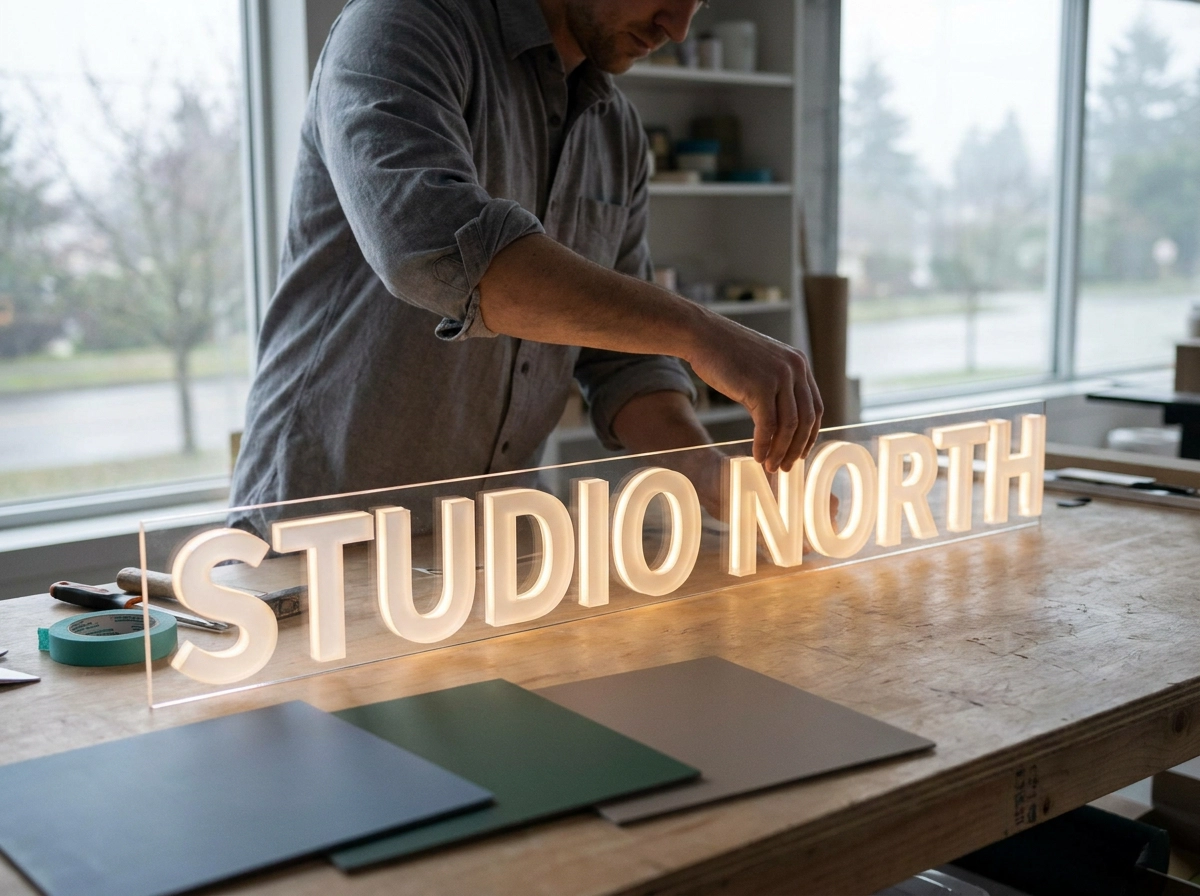
The tradeoff is outdoor durability. UV exposure and thermal cycling are acrylic’s primary failure mechanisms. Without UV-stabilized formulations or protective coatings, surface yellowing and micro-cracking typically begin within three to five years in high-UV environments. Standard-grade extruded acrylic sheet carries an industry-conventional replacement benchmark of five to seven years in direct outdoor exposure. Cast acrylic with built-in UV inhibitors and an anti-scratch coating extends that window meaningfully, particularly in temperate or low-UV climates where solar intensity and freeze-thaw cycling are less severe.
Thermal expansion compounds the problem structurally. Acrylic expands and contracts at a significantly higher rate than aluminum or steel. Rigid fastener configurations that work fine for metal panels will stress acrylic at the mounting points during seasonal temperature swings, eventually producing stress cracks that propagate inward from each hole. The fix is straightforward at the specification stage: slotted mounting holes, flexible sealants at penetration points, and clearance gaps that allow the panel to move independently of its substrate.
Acrylic performs most reliably in covered or partially sheltered locations, backlit sign cabinet faces, interior-facing window applications, and climates with moderate UV and limited freeze-thaw cycling. Full-exposure rooftop or ground-mounted installations in high-UV or freeze-thaw-heavy environments should use UV-stabilized formulations or polycarbonate alternatives, which tolerate impact stress and thermal cycling better than standard acrylic.
The practical takeaway: exterior-grade, UV-stabilized acrylic specified with proper edge sealing and thermally accommodating hardware is a durable, appropriate choice for its intended applications. The material’s mixed outdoor reputation comes almost entirely from standard-grade sheet used in environments it was never designed to handle.
Custom LED Signs: Visibility, Versatility, and System Durability
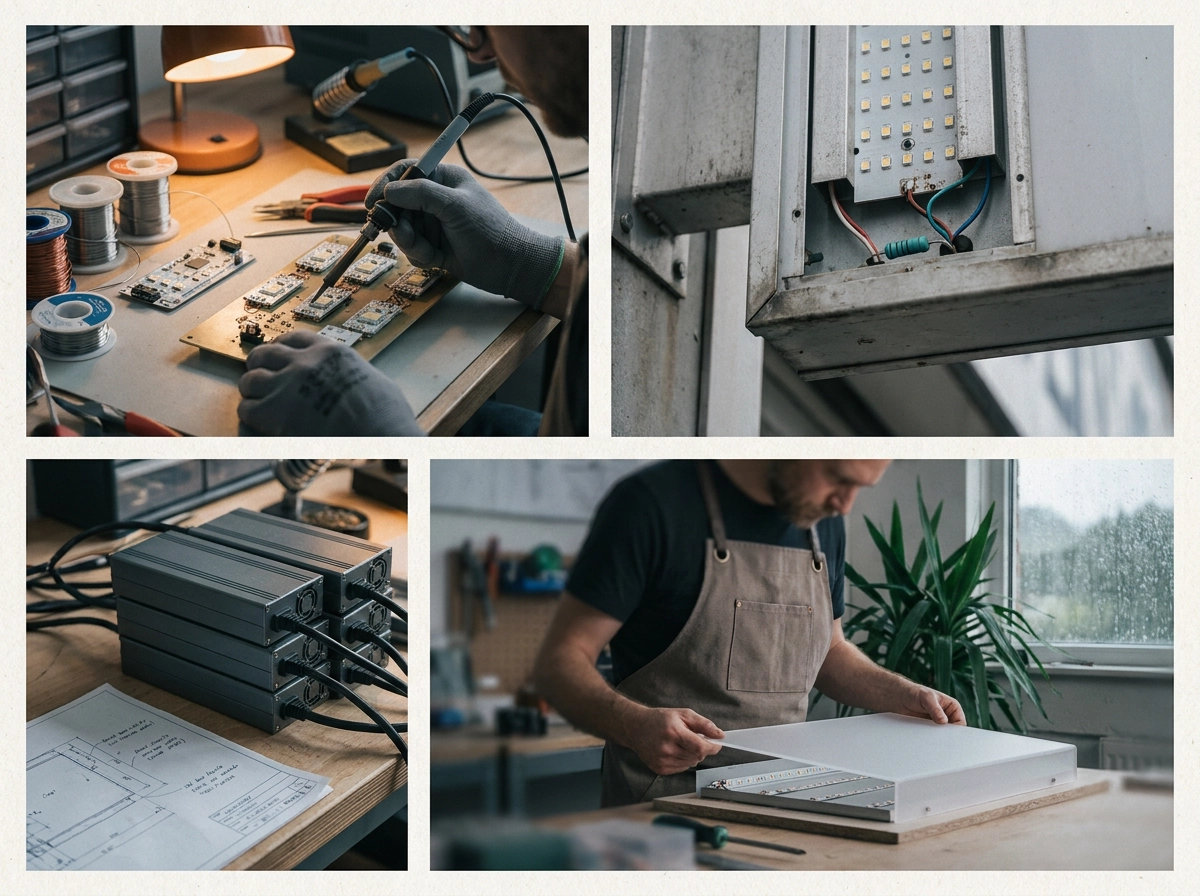
Where acrylic requires careful material upgrades to perform outdoors, LED signs introduce a different category of complexity. An LED sign is not a single substrate with a known lifespan; it is a system of interdependent components, each with its own failure modes and specification requirements.
The five components that determine LED sign durability are the LED module array, driver electronics, cabinet substrate, lens or face material, and power infrastructure. A failure in any one undermines the others. Buyers who evaluate LED signs purely on brightness or design overlook this systems reality and end up troubleshooting failures a more complete specification would have prevented.
Rated vs. Real-World Lifespan
LED module lifespan is commonly cited at 50,000 to 100,000 hours, but that figure reflects the diode array under controlled laboratory conditions. Real-world cabinet temperatures, moisture ingress, and power fluctuations compress that window when enclosure IP ratings and thermal management are not specified. Specifying the enclosure IP rating (IP65 at minimum for fully outdoor applications) and confirming the operating temperature range for the installation climate are not optional details.
Cabinet and Face Material
Cabinet substrate selection follows the same climate logic as non-illuminated signage. Aluminum cabinets outperform steel in coastal and high-humidity environments where corrosion works inward through any seam or fastener penetration. For the face material, polycarbonate holds up better than standard acrylic under UV exposure and impact stress outdoors, making it the more defensible specification for high-exposure installations.
Backlit and halo-illuminated signs built inside aluminum or fabricated metal housings combine structural durability with continuous illumination, a practical combination for any 24-hour commercial environment where readability after dark is a functional requirement.
Serviceability Is a Specification Decision
LED systems require periodic maintenance that static signs do not. Driver boards and modules will eventually need replacement, and whether that service is straightforward or expensive depends entirely on decisions made at the time of ordering. Front-serviceable and rear-serviceable cabinet designs, access panels, and weatherproof electrical connections should be specified before fabrication begins, not discovered as obstacles during a maintenance call years later.
Before ordering any custom LED sign for an outdoor application, confirm these four points with your supplier: enclosure IP rating, operating temperature range, whether the cabinet is front or rear serviceable, and whether the LED driver is internally or externally mounted. External drivers are easier to replace; internal drivers reduce enclosure penetrations. Neither is universally correct, but the answer should be deliberate.
Wood and PVC Alternatives: When Natural Aesthetics Meet Practical Performance
Not every business identity calls for the precision of machined metal or the glow of an illuminated cabinet. When a hand-crafted natural aesthetic is a deliberate brand signal, wood and PVC alternatives become legitimate specification options rather than compromises.
Species selection determines whether wood belongs outdoors at all. Cedar heartwood relies on naturally occurring thujaplicins for fungal and insect resistance, and redwood heartwood’s decay resistance correlates directly with its ethanol-soluble extractive concentration. Both are appropriate for moderate climates when heartwood-only stock is specified. Sapwood from either species carries almost no natural decay resistance, so pale bands in a board signal early failure risk regardless of finish. Osage orange, known regionally as hedge, is cited by experienced sign carvers as exceptionally durable in carved applications with minimal finishing, though buyers should request documented species verification from any fabricator making that claim.
What does not belong outdoors is equally clear. Pine, MDF, and commodity hardwoods are not outdoor sign materials, regardless of what paint system is applied over them. Seasonal moisture cycling causes dimensional movement, finish adhesion fails at end grain, and delamination follows. No coating fully compensates for a substrate that was not selected for exterior exposure.
PVC and cellular PVC lumber eliminate these failure modes entirely. They do not absorb water, do not support mold or fungal growth, and do not expand and contract seasonally, which means carved letterforms and painted surfaces remain intact through weather cycles that would stress wood over time. The visual result is nearly indistinguishable from painted wood at typical viewing distances.
A hybrid approach used by experienced sign fabricators combines both: PVC-cut dimensional letters mounted on a natural wood backing board. The letters remain dimensionally stable indefinitely, while the backing board can be refinished or replaced independently without full sign replacement.
These materials suit hospitality properties, farm and estate entrances, craft breweries, parks, and any organization where the natural aesthetic communicates something intentional about the brand.
Finish specification is not secondary to species selection; it is equally important. Properly sealed cedar in a Pacific Northwest coastal environment performs very differently than the same board in a high-UV desert installation. The finish system must be matched to the installation climate, not just the substrate species.
Matching Outdoor Sign Materials to Your Climate Zone
The finishing system discussion above hints at a larger truth: the same material can be the right choice in one region and a liability in another. Climate zone is the first variable to resolve before any substrate decision is final.
Coastal and Pacific Northwest environments combine salt spray, persistent moisture, moderate but consistent UV exposure, and frequent freeze-thaw cycling. Marine-grade aluminum, stainless steel hardware, and PVC or HDPE substrates handle this combination reliably. Cedar performs here, but only with a consistent maintenance schedule; skip a refinishing cycle and moisture infiltration accelerates faster than most buyers expect.
High-UV desert climates present a different failure profile. Intense solar radiation and extreme thermal cycling degrade surface coatings quickly and cause thermal warping in thin-gauge metals and standard acrylic. UV-stabilized polymers, powder-coated aluminum, and Corten steel are the preferred substrates here. Corten’s stable oxidation layer provides inherent corrosion resistance without relying on a surface coating that the sun will eventually break down.
Humid subtropical climates are the most demanding environment for outdoor signage. High humidity, salt proximity, intense UV, and seasonal storm loading combine in ways that accelerate failure across nearly every material category. This is the environment behind the statistic that 65% of outdoor signs in Florida require replacement within two years when materials are not climate-matched. Aluminum with marine-grade powder coat, stainless steel, or high-density polyethylene are the reliable specifications; wood and standard acrylic underperform significantly in this zone.
Temperate continental climates offer the most flexibility. Moderate UV, seasonal temperature variation, and lower humidity mean aluminum, stainless steel, UV-coated acrylic, and quality wood species all perform acceptably with correct installation and maintenance.
Multi-location organizations should resist the efficiency temptation of standardizing on one material specification across all properties. A substrate specified for a Pacific Northwest headquarters may fail early at a Southeast or Southwest location facing entirely different stressors.
Climate zone is also not a simple coastal-versus-inland determination. Elevation, proximity to reflective surfaces, building orientation (a south-facing wall in Phoenix versus a shaded north-facing wall), and local pollution levels all shift the performance envelope in ways a national generic specification will miss. Treating these variables the same way you would approach matching print formats to production requirements, by specifying the environment before selecting the material, is what separates a 15-year installation from one that needs replacement in year three.
Mounting Methods and Fastener Specifications That Affect Long-Term Durability
Even the best-specified substrate will fail ahead of schedule if the mounting system behind it was treated as an afterthought. Material selection and installation method are interdependent decisions, and skipping the second conversation routinely undermines the first.
Fastener material compatibility is where many installations quietly begin to fail. When dissimilar metals contact each other in the presence of moisture, galvanic corrosion develops at the contact point. The practical rule is straightforward: use stainless steel fasteners with aluminum substrates, stainless with stainless, and hot-dip galvanized hardware with painted steel. Zinc-plated fasteners on aluminum or stainless substrates are a common and costly mismatch. The corrosion typically begins within the first two to three years and is invisible until the fastener or surrounding substrate is already compromised.
Standoff mounting addresses a separate but related failure mode. When a sign panel mounts flush against a wall, moisture becomes trapped between the substrate and the wall surface. In wet climates, that trapped moisture accelerates surface corrosion, softens adhesives, and prevents the thermal expansion and contraction that all rigid substrates require. Spacing the panel even a half-inch from the wall surface improves drainage, allows the substrate to move, and significantly extends installation life. In high-rainfall environments, flat-mount installations frequently show corrosion or adhesive failure within a few years regardless of substrate quality.
Wind load engineering applies to any ground-mounted or pole-mounted sign. Sign area, post height, substrate weight, and local wind speed data collectively determine minimum post diameter, footing depth, and bracket gauge. These are not conservative estimates to negotiate away; they reflect the structural loads a sign will experience repeatedly over a 15-year service life.
Adhesive-only mounting is appropriate only for sheltered applications with limited thermal cycling and no direct wind exposure. For any exterior sign exposed to weather, specify mechanical fasteners with sealant applied at each penetration point to prevent water ingress behind the substrate.
Defining the installation method in writing before fabrication begins also protects warranty coverage. Most sign warranties are written around a specified installation standard; when that standard is left to installer discretion, warranty claims become difficult to enforce if a structural issue develops later.
Total Cost of Ownership: Why the Cheapest Sign Rarely Is
Substrate and mounting decisions determine whether a sign survives its first decade. What they don’t reveal on their own is what that sign actually costs over time.
Total cost of ownership for outdoor signage includes initial fabrication, installation, periodic maintenance, and eventual replacement, amortized across the intended service life. Comparing only upfront price between material options systematically undercounts the true cost of lower-durability choices.
The math is straightforward. A standard acrylic sign requiring replacement every five to seven years at $800 per cycle costs $1,600 to $2,400 over a 15-year period, before accounting for removal and reinstallation labor. A powder-coated aluminum sign at twice the initial price, requiring only one re-coating at year ten, comes in lower over that same horizon while delivering a more consistent appearance throughout. The acrylic option looks cheaper at the point of purchase and more expensive by year eight.
The 65% two-year replacement rate documented in climate-mismatched Florida installations represents the extreme end of this calculation. But even a single unplanned replacement cycle on a monument sign or building-mounted identification sign typically erases any savings from the lower-cost substrate. Removal, refabrication, and reinstallation costs compound quickly.
Maintenance obligations also differ significantly by material. Stainless steel requires little beyond periodic cleaning. Aluminum in harsh climates needs re-coating every seven to ten years. Wood requires annual inspection and periodic refinishing to stay structurally sound. LED systems involve module and driver maintenance on a longer but less predictable schedule, with costs that depend heavily on how serviceable the cabinet was specified at the outset.
For organizations managing multiple locations, negotiating material and fabrication standards upfront with a long-term signage partner creates cost predictability across the portfolio and eliminates the inconsistency that accumulates when each sign is purchased as a one-off.
TCO analysis is also a practical internal approval tool. Facilities and procurement buyers who present a 15-year cost model, rather than a unit price, tend to gain approval for durable specifications that would otherwise be rejected on sticker price alone.
What to Specify Before You Order: A Practical Checklist for Buyers
Translating a 15-year cost analysis into an actual purchase order requires one more step: documenting what you need before a vendor quotes it. Most specification failures happen not during fabrication but before the conversation starts, when buyers hand off a vague request and accept whatever defaults the supplier applies. This checklist closes that gap.
Installation environment. Record climate zone, average daily sun hours, and compass orientation of the mounting surface. Note proximity to salt water, industrial emissions, or high-traffic vehicle exhaust. Specify mounting type: ground-mounted, wall-mounted, or pole-mounted. These inputs determine material eligibility before any other decision is made.
Substrate and finish. Name the alloy or formulation, not just the material category. “Aluminum” is insufficient; specify alloy grade, finish system (powder coat, anodize, wet paint, or UV-protective laminate), minimum coating thickness, and whether UV stabilization is required given the sun exposure hours documented above.
Hardware and fasteners. Specify fastener material matched to the substrate to prevent galvanic corrosion. State the mounting method: standoff, flush, post-and-panel, or cabinet. Require sealant at all penetration points. If the sign exceeds a threshold size or mounts on a freestanding structure, ask whether wind load engineering documentation is required by local code.
Viewing distance and visibility. State the primary viewing distance. That number drives minimum letter height, contrast ratio, and whether illumination is necessary for custom outdoor signs for business that must remain readable in low-light or high-speed roadway environments.
Lifespan and maintenance. State your minimum acceptable service life in years, your maintenance budget and frequency tolerance, and any local permit or illumination code requirements the installation must satisfy.
Supplier documentation. Before fabrication begins, request material certifications, finish specifications, and installation instructions in writing. A qualified sign partner provides these as standard practice and will flag specification gaps the buyer may not have anticipated, which is a practical test of whether a supplier is worth working with long term.
How OneStop Northwest Supports Outdoor Signage Projects
Putting together a complete sign specification is only half the work. Sourcing the fabrication, coordinating across sign types, and keeping documentation consistent over a multi-year program is where many organizations lose time and brand consistency.
OneStop Northwest works with organizations across the Pacific Northwest and nationwide to specify, source, and manage signage programs, applying the same single-source model we use for branded apparel programs and managed procurement to every signage engagement. That means one relationship covering custom metal signs, custom acrylic signs, custom LED signs, dimensional letters, monument bases, wayfinding systems, and specialty substrates, rather than separate vendors for each sign category.
For healthcare systems, government agencies, hospitality groups, schools, and multi-location employers managing signage across different sites and climate zones, a single coordinating partner removes the fragmentation that makes signage programs difficult to maintain. Material specifications, graphic standards, and procurement records stay in one place, with one point of accountability.
The integration extends beyond fabrication. Outdoor sign graphics connected to interior wayfinding, vehicle graphics, branded apparel, and print materials produce a consistent visual identity across every touchpoint an organization controls. That alignment rarely happens when signage is purchased separately from the rest of a brand program.
Clients who work with us on multi-year signage programs also benefit from documented specifications that stay with each project. When staff or vendors change mid-cycle, those records prevent the institutional knowledge loss that forces organizations to re-engineer specifications they already paid to develop.
To learn more about how we support organizations with signage and broader brand programs, visit our brand management and partner solutions page or connect with our team directly.
Specify for the Long Term, Not Just the Budget Meeting
Every outdoor sign decision reduces to the same core question: what does this installation need to survive, and for how long? Start with climate zone and intended service life, then work backward to material selection. Starting with the price list reverses that logic and is the primary reason signs fail before the budget cycle that funded them has even closed.
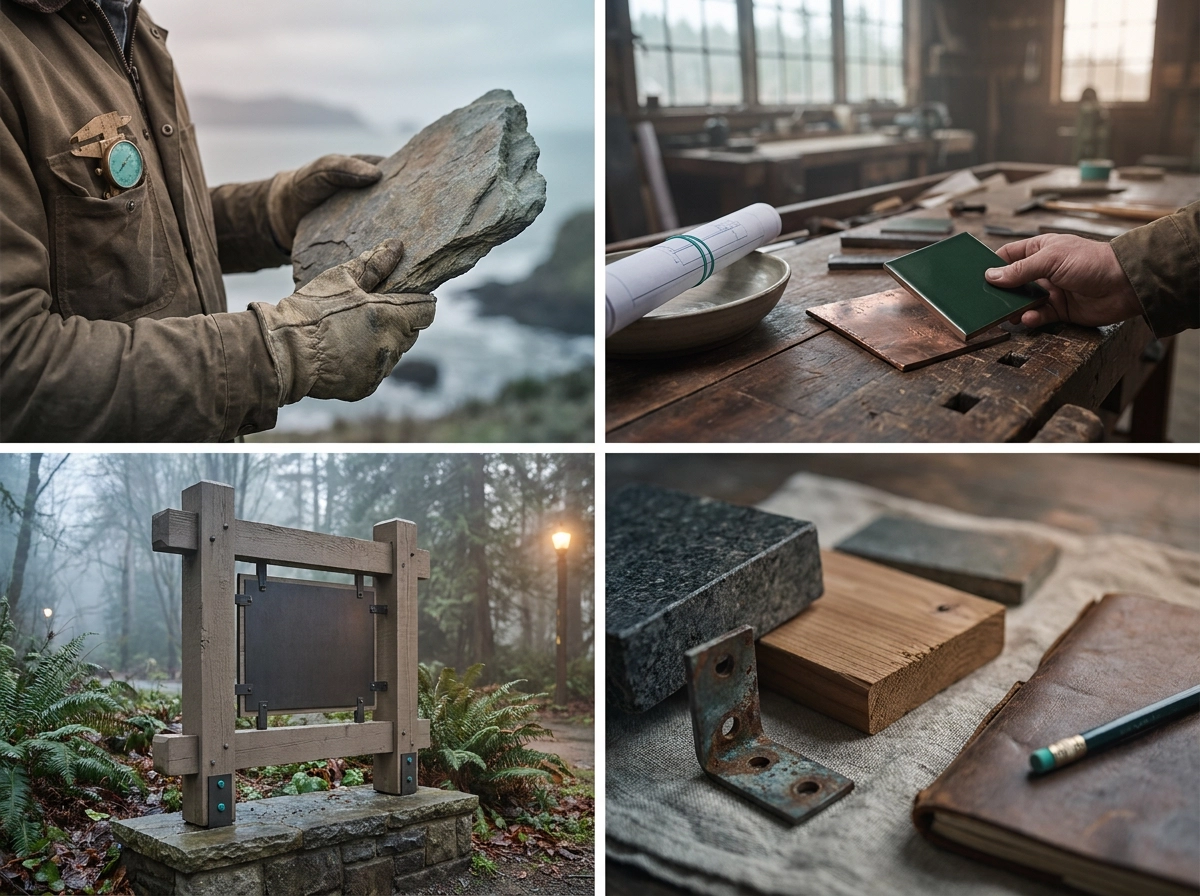
No single material is universally correct. Metal, acrylic, LED systems, wood, and PVC alternatives each have environments where they perform well and conditions where they will fail early if placed there without the right specification. The decision is not which material is best in the abstract; it is which material is appropriate for this location, this exposure profile, and this service life target.
Substrate choice, however, does not stand alone. Mounting method, fastener material, and finish specification carry equal weight in determining how long an installation lasts. A correctly specified aluminum panel mounted with mismatched zinc hardware in a coastal environment will fail at the fastener points long before the panel itself degrades. These variables deserve the same deliberate attention as the substrate decision, not afterthought treatment during installation.
The most useful financial frame for any durable sign purchase is total cost of ownership across 10 to 15 years. The upfront unit cost comparison flattens differences that compound significantly over a replacement cycle or two. A more durable specification almost always justifies itself when the full timeline is on the table.
Buyers who document their environmental requirements, minimum service life expectations, and acceptable maintenance frequency before engaging a vendor consistently get more accurate quotes, fewer mid-project surprises, and installations that are still performing at year ten. That documentation is not complexity; it is the simplest protection available against an unplanned replacement budget.
Conclusion
Outdoor signage that lasts begins with four decisions made correctly: choosing a substrate matched to your specific climate and exposure profile, specifying mounting hardware that is compatible with that substrate, understanding total cost of ownership rather than unit price alone, and documenting your requirements before the first vendor conversation.
Get those four decisions right, and your sign performs for a decade or more without unplanned replacement costs. Get them wrong, and the savings from a lower initial quote disappear within a few years.
OneStop Northwest brings the technical depth and project experience to help you specify correctly from the start. Whether you are planning a single exterior panel or a multi-location installation, the right specification process protects your investment and your brand.
Start with your environment, define your service life target, and build your specification from there. Everything else follows.
Frequently Asked Questions
Why do 65% of outdoor signs in Florida require replacement within two years?
The high replacement rate in Florida is due to materials not being matched to local climate conditions. Florida's humid subtropical climate combines high humidity, salt proximity, intense UV exposure, and seasonal storm loading—stressors that accelerate failure across nearly every material category. This is a procurement failure caused by specifying signs based on price rather than performance, not a manufacturing defect. Proper material selection matched to climate conditions can extend sign lifespan to 10-15 years or more.
What is the difference between total cost of ownership and upfront price for outdoor signs?
Total cost of ownership includes initial fabrication, installation, periodic maintenance, and eventual replacement amortized across the intended service life—typically 10-15 years. A cheaper sign requiring replacement every 5-7 years may cost $1,600-$2,400 over 15 years, while a higher-priced durable option costing twice as much but requiring only one re-coating may be significantly less expensive overall. The upfront unit price comparison systematically undercounts the true cost of lower-durability choices and often results in false economy.
Which material should I choose for a coastal or Pacific Northwest environment?
For coastal and Pacific Northwest environments that combine salt spray, persistent moisture, moderate UV exposure, and freeze-thaw cycling, marine-grade aluminum, stainless steel hardware, and PVC or HDPE substrates handle these conditions reliably. Marine-grade stainless steel, while carrying a higher upfront cost, frequently offers better long-term value than aluminum in these demanding conditions. Cedar can also perform well in this climate, but only with a consistent maintenance schedule and proper finishing.
What is galvanic corrosion and how do I prevent it in outdoor signs?
Galvanic corrosion occurs when dissimilar metals contact each other in the presence of moisture, developing corrosion at the contact point. A common costly mistake is using zinc-plated fasteners on aluminum or stainless steel substrates, which typically causes invisible corrosion to begin within 2-3 years. Prevention is simple: use stainless steel fasteners with aluminum substrates, stainless with stainless, and hot-dip galvanized hardware with painted steel. Matching fastener metal to substrate metal costs nothing extra to specify upfront.
Why is standoff mounting better than flush-mounting an outdoor sign?
When a sign panel mounts flush against a wall, moisture becomes trapped between the substrate and wall surface, accelerating surface corrosion, softening adhesives, and preventing necessary thermal expansion and contraction. Spacing the panel even a half-inch from the wall surface through standoff mounting improves drainage, allows the substrate to move, and significantly extends installation life. In high-rainfall environments, flat-mount installations frequently show corrosion or adhesive failure within a few years regardless of substrate quality.