

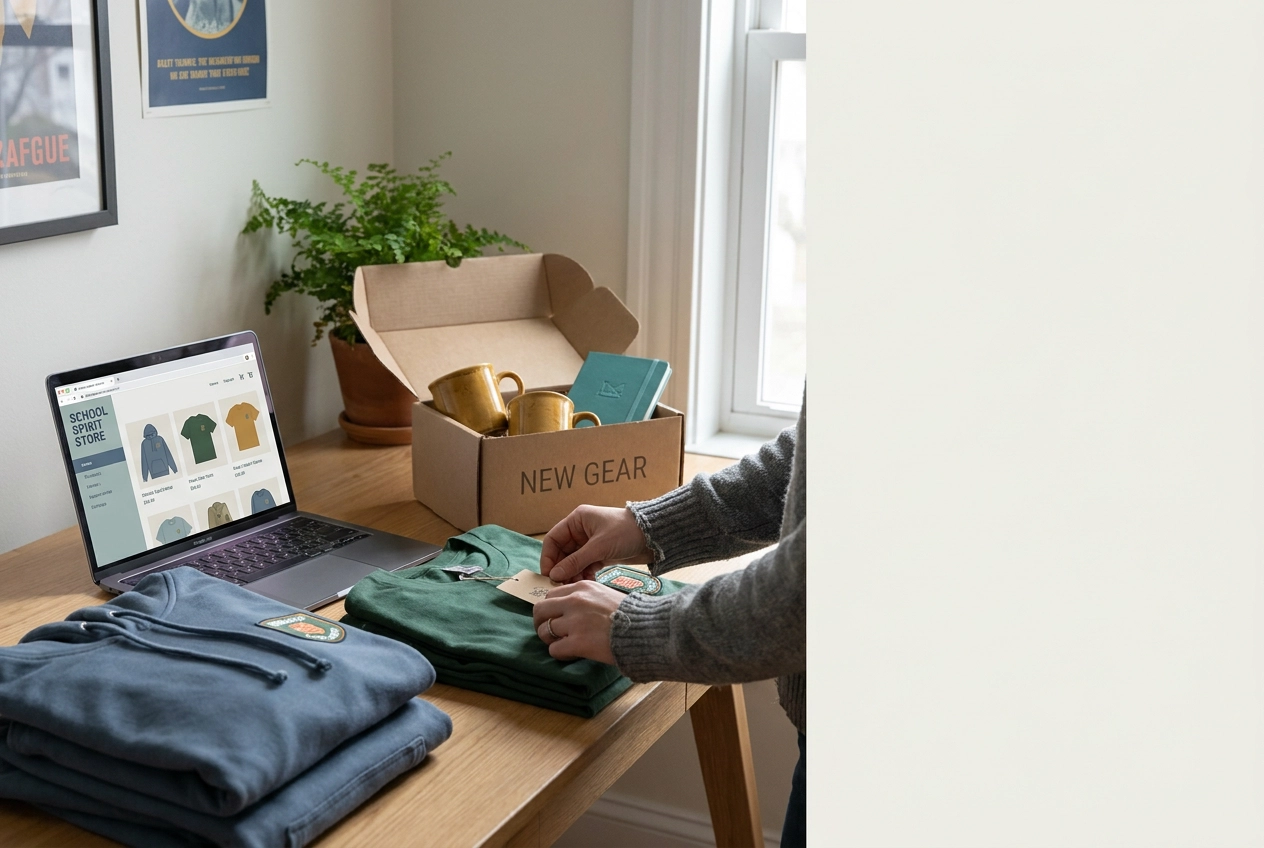
Someone just handed you the job of launching a school spirit shop, and you have no idea where to start. Maybe you volunteered at a booster club meeting, or maybe your athletic director dropped it in your lap last Tuesday. Either way, you’re now responsible for getting branded gear into the hands of students, parents, and fans, and the clock is already ticking.
Here’s the good news: setting up a school spirit store is absolutely doable, even if you’ve never managed a retail operation in your life. The key is knowing what to tackle yourself and what to hand off to the right partner.
This guide walks you through the entire process from start to finish. You’ll learn how to get school leadership on board, define what your store actually sells, choose the right setup for your situation, and keep sales running all year long, not just on game days. We’ll also cover the mistakes first-timers typically make and show you how a managed solution like OneStop Northwest can take the heaviest parts of the job completely off your plate. Let’s get into it.
Before You Start: Governance, Compliance, and Stakeholder Alignment
Before you build a product catalog or pick a vendor, you need to get a few organizational questions settled. Skipping this part is the single most common reason spirit store launches stall before they start.
Confirm who actually owns the decision. Is this the booster club’s initiative, the athletic department’s, or a shared effort between both? If two groups both think they’re in charge, you’ll end up with conflicting directions, duplicated work, and a launch that drags on for months. Nail this down first, in writing if possible, and identify one person who has final say on vendor selection and store setup.
Get administrative sign-off before you commit to anything. Many school districts have formal approval requirements for outside vendors. That means your principal and athletic director should be in the loop before you sign up for any platform or place an order. A brief conversation up front prevents a much longer problem later.
Understand your nonprofit obligations. If your booster club holds tax-exempt status, every dollar that moves through your spirit store needs to be documented. Revenue, vendor payments, and expenses must be tracked and auditable. A well-run store should make your financial reporting easier, not harder. If your current record-keeping is already a challenge, factor that into how you set up the store. This is also worth discussing with whoever manages the booster club’s finances before you launch.
Consider whether a school-wide structure makes sense. Many school administrators and athletic associations favour a unified booster structure over sport-by-sport fragmentation, setting up a single spirit store is one practical step in that direction. If your school runs fragmented sport-by-sport groups, a single spirit store simplifies vendor relationships, reporting, and revenue distribution in one move.
Not sure whether a spirit store fits a team store structure or something else entirely? The breakdown in Company Store vs. Team Store vs. Employee Portal: Which Branded Merchandise Structure Fits Your Organization? can help you figure out which model fits your situation before you build anything.
Step 1: Define Your Store’s Scope
Once your governance questions are settled, the next decision is equally foundational: what, exactly, is your store trying to do?
Start by identifying who you’re building the school spirit shop for. A store that serves the entire school community (students, staff, parents, and alumni) will need a broader product mix than one built for a single varsity program. Neither approach is wrong, but broader scope means more products, more logo variations, and more coordination. For a first launch, a tighter audience is easier to execute well.
Who will shop your store?
- Students and staff: your highest-frequency buyers
- Parents and families: strong purchasers around seasons and events
- Alumni: occasional but valuable, especially around homecoming
- Multiple sport-specific booster clubs: possible, but adds catalog complexity
Pick your primary audience first. You can expand later.
Seasonal or year-round?
This is one of the most consequential choices you’ll make. A store that opens for two weeks around homecoming and closes until spring is leaving consistent revenue uncollected. Buyers who would have purchased in December or March simply have no option.
A year-round school spirit online store keeps revenue flowing between events, reduces the pressure on any single sales window, and builds habitual purchasing among families who check back regularly. Casual fans who miss homecoming can still buy at Thanksgiving or before graduation. Ready to Build Your Store?
Build a purchase-occasion calendar
List every event that could drive a sale: fall sports kickoff, homecoming, winter sports season, spring athletics, graduation, and back-to-school. That list is not just a promotional schedule; it tells you which products to feature and when to refresh your catalog.
Set a realistic revenue goal
A 500-student school with modest engagement needs a different store than a 2,000-student district running five active booster clubs. A rough goal helps you decide how many products to carry, whether to use on-demand production or bulk ordering, and how much time the coordinator realistically needs to invest. Size the store to the audience you actually have, not the one you’re hoping for.

Step 2: Decide How You Will Run the Store
Once you know your scope, the next decision shapes everything else: how will the store actually run?
There are three realistic options.
Fully DIY means you source products, find a decorator, set up payment collection, manage inventory, and ship or distribute orders yourself. It sounds straightforward until you’re coordinating three separate vendors, chasing a screen printer on a deadline, and answering emails from parents asking where their hoodie is. Most volunteers and part-time staff weren’t hired to run a merchandise operation, and the learning curve is steep.
Print-on-demand platforms reduce inventory risk by producing items one at a time as orders come in. That’s a real advantage if you’re worried about overstocking. The tradeoff is that product selection tends to be limited, decoration quality is often inconsistent, and bulk orders for teams needing matching apparel in specific sizes and colors are where these platforms struggle most.
A managed full-service solution means a partner handles sourcing, decoration, the online store, order processing, and fulfillment on your behalf. Your job becomes promotion and communication rather than logistics. This is the model worth understanding if your goal is a store that runs reliably without consuming the coordinator’s available hours.
The comparison most people make is per-unit cost, but that’s the wrong measure. The real question is total cost of ownership. Coordinator time spent managing vendor relationships, tracking down late orders, and resolving fulfillment issues has genuine cost, even when the person doing it is a volunteer. A program that looks cheaper on paper can become expensive in practice once you account for the hours it consumes.
For organizations that have already navigated this tradeoff in other contexts, the logic mirrors what’s laid out in this breakdown of managed apparel programs versus one-off procurement: the operational burden of treating every order as a separate project accumulates quickly.
Choose the model that matches your actual capacity, not your most optimistic estimate of it.
Step 3: Choose Your Products Carefully
Once you’ve settled on how you’ll run the store, the next decision is what you’ll actually sell.
Start smaller than you think you need to. A focused assortment, rather than a sprawling catalog, makes it easier for buyers to choose and reduces the risk of slow-moving inventory. If you’re holding physical inventory, items that don’t move tie up booster club funds.
Build around proven categories first:
- Apparel: Performance tees, cotton tees, hoodies, and crewnecks cover the bulk of demand across seasons and age groups
- Headwear: Structured hats and beanies give buyers a lower-priced entry point and sell well year-round
- Bags and drinkware: Backpacks, cinch bags, and insulated tumblers hold up, get used daily, and keep your school’s brand visible long after the game ends
- Spirit accessories: Lanyards, decals, and buttons round out the assortment at low price points, which is useful for impulse purchases or younger buyers with limited budgets
Decoration method matters more than most first-timers realize. Embroidery signals quality and is a natural fit for outerwear and hats. Screen printing suits high-volume tee runs with a consistent design. Heat transfer suits small batches or individual names and numbers. Choosing the right method per product type keeps costs in check without sacrificing how items look. For a broader look at decoration options and branded merchandise programs, the Programs to Power Your Branded Merchandise overview is worth a look.
On-demand or made-to-order production removes the inventory risk entirely. When items are produced as orders come in, you can offer more variety without committing to stock upfront.
Plan for seasonal shifts from day one. Fall calls for outerwear and performance layers. Winter favors hoodies and warm accessories. Spring and summer shift toward tees, hats, and drinkware. A catalog that doesn’t rotate loses relevance and sales well before the school year ends.
Step 4: Set Up Your School Spirit Online Store
With your product lineup decided, the next step is giving buyers a place to shop, one that works at 10 p.m. on a Tuesday, not just at Friday’s game.
A dedicated online store removes the cash box from the equation entirely. Every transaction is recorded automatically, which matters when your booster club needs clean financial documentation at year-end. No more tallying up envelope money or reconciling handwritten order forms.
Get your branding approved before you build anything. The store should use your school’s official colors, mascot, and logo, but most districts have guidelines about who can use school marks and how. Check with your principal or athletic director before those assets get loaded into any product templates. Fixing artwork after the store is built takes more time than getting sign-off upfront.
Keep the shopping experience simple. Parents and students aren’t shopping on a specialized retail platform every day. If checkout requires creating an account, entering a promo code, choosing a pickup location, and answering three optional questions, you will lose buyers before they finish. Every unnecessary step is a reason to quit, aim for a checkout process that takes under two minutes for a returning visitor.
Put the store URL everywhere. The athletic department website, the booster club newsletter, school social media accounts, and every email that goes home to families. If parents have to search for the store, most won’t bother. Make the link impossible to miss and easy to share.
If a managed partner is building and hosting the storefront, verify a few things before you go live:
- Mobile-friendly layout. A significant share of purchases will happen on phones.
- School branding applied throughout, not just on the header image.
- Secure payment processing handled by the partner, so your booster club doesn’t need to set up its own merchant account or take on payment compliance responsibilities.
A well-built store handles these details quietly in the background, so buyers just see your school’s colors and an easy path to checkout.
Step 5: Handle Orders and Fulfillment Without Losing Control
Getting the store built is the straightforward part. Keeping up with orders after people start buying is where most DIY spirit store setups quietly fall apart.
Coordinators who handle fulfillment themselves quickly discover that batching orders, following up with the decorator, sorting items by size and buyer, and arranging distribution is a significant time commitment, and it repeats every order cycle. Most volunteers don’t sign up expecting to spend weekends sorting hoodies.
Choose your delivery method before you launch, not after.
You have two basic options: ship directly to buyers’ homes, or collect orders in batches and distribute through the school. School pickup keeps shipping costs off the buyer, which can improve conversion, but it puts the sorting and distribution work on whoever is running the program. If you go that route, set a fixed pickup schedule and stick to it. Ad hoc distribution creates confusion and follow-up messages asking where orders are.
Direct-to-home shipping adds a per-order cost but removes the distribution burden entirely. A combination approach, where local families pick up and out-of-town alumni or staff receive shipments, can work well once the program is established.
In a managed store model, most of this work disappears.
When a partner handles production and fulfillment, orders ship directly to buyers or arrive at the school in organized, labeled batches. The coordinator’s role becomes communication and promotion rather than logistics. That shift matters a lot when the person running the store is a part-time staff member or volunteer with other responsibilities.
Timelines and quality control are not optional.
Publish clear order windows and production timelines on the store and in every promotion. Buyers who don’t know when to expect their items will follow up, and those questions take time to answer. Vague timelines erode confidence in the program faster than almost anything else.
Before orders reach buyers, someone needs to verify that items are correct and print quality meets expectations. In a managed solution, that inspection happens at the decorator level. In a DIY setup, build that checkpoint into your process explicitly, because it will not happen by default.
Step 6: Promote Your School Spirit Shop
Once fulfillment is sorted out, getting people to actually visit the store becomes your next job. A great store with no promotion is just a website nobody finds.
Tie announcements to the school calendar. Generic “check out our spirit store” messages get ignored. What works better is timing your announcements to moments when school pride is already high: the first week of fall sports, the week before homecoming, and the lead-up to any event that draws families and alumni together. Buyers who are already engaged are far easier to convert than buyers you have to create from scratch.
Use the communication channels you already have. You don’t need a marketing budget. Parent email lists, the athletic department’s social accounts, the school website, and printed materials sent home at the start of the year are already reaching your audience. Drop the store URL into every one of them. The more places a parent sees the link in a natural context, the more likely they are to click it.
Let coaches carry the message to families. A note from a coach asking families to support the team through the spirit store lands differently than a general announcement from the booster club. Coaches and team captains have direct relationships with families, and a personal ask carries real weight. A quick message in a team group chat or a mention at a parent meeting can drive more traffic than a school-wide email blast.
Show something new each time you promote. If every announcement says the same thing, people stop reading. Rotating in seasonal products, new colors, or items tied to an upcoming event gives returning visitors a reason to come back to the school spirit online store. Even a small refresh keeps the store feeling active.
Use deadlines to concentrate purchasing. A homecoming sale with a defined close date can concentrate purchasing by giving buyers a reason to act now, that urgency is easy to build around events already on the school calendar.
Step 7: Keep the Store Running Year-Round

Promotion drives traffic, but consistency drives revenue. Once your store is live and your seasonal campaigns are running, the goal shifts from launching to sustaining.
The most common missed opportunity in school spirit programs is closing the store after a big event. A store that goes dark after homecoming forfeits every purchase that would have happened in November, December, and January, including holiday gift buyers, winter sports families, and anyone who simply missed the fall window. Keeping the store open year-round converts those moments into revenue instead of lost sales.
Assign one person to own the store. This can be a volunteer, a booster club officer, or an athletic department staffer. The title matters less than the accountability. Stores without a designated owner tend to go dormant quietly; no one updates products, no one sends promotions, and traffic fades. One person with clear responsibility prevents that.
Run a product review every quarter. Pull up what’s in the store, note what’s selling, and retire anything that isn’t moving. Add items that fit the upcoming season or reflect what’s current with your student body. Seasonal rotation, covered in Step 3, applies equally to the year-round maintenance cycle.
Let your sales data guide decisions. If you’re working with a managed store partner, order history and reporting come built in. You can see what sold, in what sizes, and during which windows, without building your own tracking system. A DIY setup requires pulling that information manually across however many vendors you’re managing, which takes time most coordinators don’t have.
Keep your financial records clean. Booster clubs operating as nonprofits have financial management obligations that include documented transaction records. A managed store generates that record automatically, which makes annual reporting straightforward and supports transparency with school administration and your parent community.
Common Mistakes First-Time School Spirit Stores Make
Even a well-planned store can stumble if a few common operational traps aren’t avoided from the start. These mistakes show up repeatedly with first-time coordinators, and most are preventable.
Overstocking on unproven items. Ordering 200 hoodies in a mix of sizes before you know what your buyers actually want is one of the fastest ways to drain booster club funds. You may sell out of mediums and larges in the first week and spend the rest of the year staring at a stack of 3XLs nobody claimed. Start with made-to-order or small test runs before committing to bulk inventory.
Letting the store go dormant. A store that goes dark after homecoming trains buyers to stop checking, consistency matters more than any single sales event.
Managing too many vendor relationships. Splitting sourcing across multiple vendors multiplies coordination costs; a single managed partner eliminates that friction.
Skipping cash flow planning. Many decorators require payment before they start production. If your store collects orders on a rolling basis without enough upfront revenue to cover that deposit, you can find yourself personally advancing funds or delaying fulfillment. Understanding the payment sequence before you launch prevents that position entirely.
Ignoring mobile buyers. Many parents browse and buy on mobile devices, a checkout that isn’t mobile-optimized will lose those buyers.
How OneStop Northwest Handles the Hard Parts
Those common mistakes share a root cause: coordinators trying to manage too many moving parts without the right infrastructure behind them. That’s exactly the problem a managed school spirit store is designed to solve.
OneStop Northwest handles the full operation, from product sourcing and online store setup to order processing and fulfillment. A coordinator’s job becomes promotion and communication, not chasing a screen printer or sorting a pallet of mismatched hoodies.
Access to products without large upfront commitments
Through a national supplier network and more than $2 billion in collective buying power, OneStop provides access to a wide range of branded apparel and merchandise at competitive pricing, with low or no minimums on many items. For a booster club that can’t afford to pre-order 150 units of an untested style, that flexibility is practical rather than just convenient.
Decoration without vendor management
Embroidery, screen printing, and other decoration methods are handled in-house or through vetted partners. Quality control is built into that process. A coordinator doesn’t need to understand the difference between decoration methods, negotiate turnaround timelines, or inspect finished goods before distribution. If you want background on how printing formats affect cost and quality before briefing any vendor, this overview of commercial printing formats and how offset, digital, and wide-format each fit different project types is worth a read.
Financial records that make reporting easier
The managed store generates a clean order and transaction history automatically. When annual financial review time arrives, the booster club treasurer has organized records rather than a folder of email threads and handwritten tallies.
Scales with the program, not the coordinator’s workload
OneStop works with schools across Washington State, the Pacific Northwest, and nationwide. A small booster club in Western Washington and a multi-sport district-wide program both get the same managed model; the scale changes, the operational burden on the coordinator does not.
Partner with OneStop Northwest to learn what a managed school spirit store program would look like for your school.
Getting Your School Spirit Store Off the Ground
The steps in this guide give you a complete picture of what’s involved. The actual work of launching comes down to three things: a defined scope, the right operational model, and a promotion plan that stays active across the school year.
You don’t need to become an expert in apparel sourcing, decoration methods, or order fulfillment to run a successful school spirit store. Those are the parts a managed solution handles. What you do need is clarity on who the store serves, which products make sense to start with, and how you’ll keep buyers engaged between the big events on the calendar.
The operational model is the decision that shapes everything downstream, choose it based on actual coordinator capacity, not optimistic estimates.
The same principle that applies to your product selection applies to the launch itself: start focused, stay consistent.
If you’re ready to move forward, reach out to OneStop Northwest to learn how a managed school spirit store program works in practice. Whether you’re starting from scratch or replacing a process that isn’t working, the conversation starts with your school’s specific situation, not a one-size-fits-all package.
Conclusion

A spirit store that lasts is built on clear scope, the right operational model, and a promotion plan that stays active all year.
If your school is ready to build a spirit store that actually lasts, reach out to OneStop Northwest today. Tell us where you are starting from, and we will help you build something your community will come back to again and again.
Frequently Asked Questions
What's the biggest mistake first-time school spirit store coordinators make?
The single most common reason spirit store launches stall is skipping governance and compliance questions at the start. Before building a catalog or picking a vendor, you need to confirm who owns the decision (booster club, athletic department, or both), get administrative sign-off from your principal and athletic director, understand nonprofit financial obligations, and consider whether a school-wide structure makes sense. This foundational work prevents months of delays and conflicting directions later.
Should I run a seasonal spirit store or keep it open year-round?
A year-round school spirit online store is significantly better than a seasonal approach. Stores that close after homecoming forfeit revenue throughout November, December, January, and beyond—including holiday gift buyers, winter sports families, and anyone who missed the fall window. A year-round model keeps revenue flowing between events, reduces pressure on single sales windows, and builds habitual purchasing among families who check back regularly. The key is assigning one person to own the store and rotating products seasonally to keep offerings relevant.
What's the difference between running a DIY store, using print-on-demand, and hiring a managed solution?
DIY means you source products, find a decorator, manage inventory, and handle shipping yourself—but most volunteers aren't prepared for vendor coordination and customer service. Print-on-demand reduces inventory risk by producing items as orders arrive, but offers limited product selection and struggles with bulk team orders. A managed full-service solution handles sourcing, decoration, the online store, and fulfillment for you, so your job becomes promotion rather than logistics. The real comparison is total cost of ownership, not per-unit cost—coordinator time spent managing vendors has genuine value, even for volunteers.
How do I decide what products to sell in my school spirit store?
Start smaller than you think you need to. Focus on proven categories first: apparel (performance tees, hoodies, crewnecks), headwear (hats, beanies), bags and drinkware (backpacks, tumblers), and spirit accessories (lanyards, decals, buttons). Choose decoration methods strategically—embroidery signals quality for outerwear and hats, screen printing suits high-volume tee runs, and heat transfer works for small batches. Plan for seasonal shifts from day one: fall needs outerwear, winter favors hoodies, and spring/summer shift toward tees and drinkware. On-demand or made-to-order production eliminates inventory risk entirely.
What's the best way to promote my school spirit store to drive sales?
Tie announcements to your school calendar rather than sending generic messages—timing promotions around fall sports kickoff, homecoming, winter sports season, and other high-engagement moments works much better. Use communication channels you already have: parent email lists, athletic department social media, the school website, and printed materials. Let coaches personally ask families to support teams through the store—a message from a coach carries more weight than a general booster club announcement. Show something new each time you promote (seasonal products, new colors, event-specific items), use defined deadlines to concentrate purchasing, and put the store URL everywhere so parents can't miss it.