

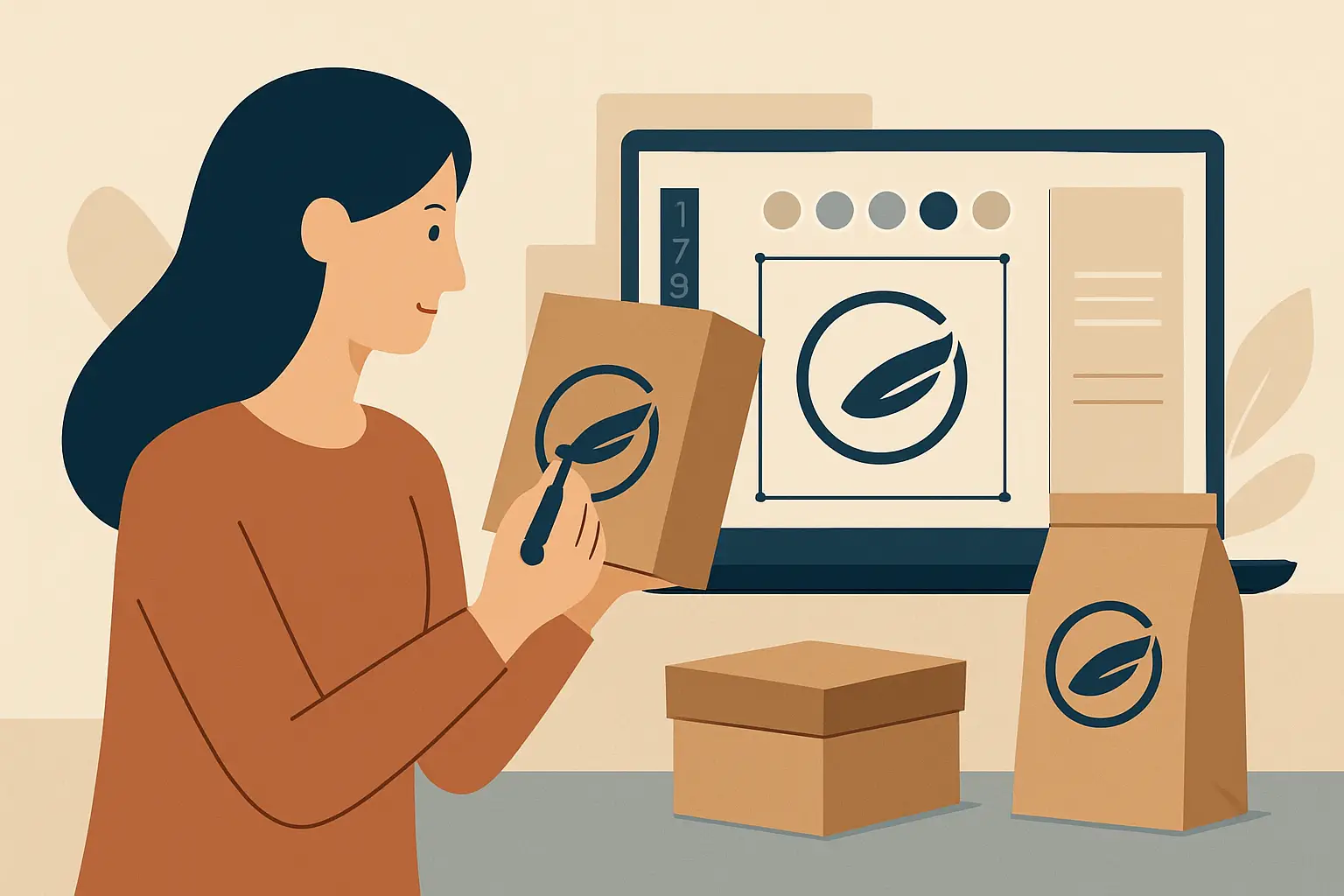
A customer can forget your ad in five minutes. They rarely forget the moment they hold your product in their hands – especially if the box, label, or pouch feels unmistakably “you.” That moment is where packaging stops being a container and starts doing the hard work of brand building.
For many small and mid-sized businesses, packaging is also one of the only brand touchpoints you fully control. Your website competes with a thousand tabs. Your social posts compete with everyone’s feed. But your packaging sits on a countertop, gets carried into offices, shows up in unboxing videos, and gets photographed on shelves. If you want brand recognition that sticks, packaging design for brand identity is one of the highest-leverage places to invest.
What packaging really does for brand identity
Brand identity is not just a logo. It’s the set of cues that help people recognize you quickly and feel something consistent every time they interact with you. Packaging is a shortcut to that consistency.
When packaging is doing its job, it makes three things happen at once. First, it helps someone find you or choose you – on a shelf, in a catalog, or in a stack of deliveries. Second, it reassures them they made a good decision because the product looks credible and intentional. Third, it builds memory – a visual and tactile “stamp” that makes the next purchase easier.
That’s why packaging often has a bigger impact on repeat purchases than businesses expect. It’s not because people are obsessed with boxes. It’s because packaging repeatedly trains the brain: same colors, same patterns, same tone, same quality cues. Over time, recognition becomes instinct.
Start with the moment your customer meets the package
A practical way to design packaging that strengthens identity is to define the primary “meet” moment. Retail packaging has a different job than e-commerce packaging, and B2B shipments are different from direct-to-consumer subscriptions.
If you sell in retail, the meet moment is usually three seconds on a shelf. Your packaging needs to read fast from a few feet away: clear product type, clear brand cues, and a visual hierarchy that makes sense.
If you sell online, the meet moment is delivery day. The customer sees the exterior first, then opens it, then notices inserts, labels, and how the product is protected. Here, brand identity shows up through the whole experience: the unboxing, the materials, even how you handle returns.
For government and organizational buyers, the meet moment can be when a shipment arrives at a receiving dock and gets distributed internally. In that case, clarity, compliance, and consistent labeling can matter as much as aesthetics. Your identity still shows up – just in a more operational way.
The point is simple: good packaging design starts by being honest about where the decision and impression actually happen.
The brand cues that do the heavy lifting
Most businesses think brand identity on packaging is “put the logo on it.” The logo helps, but the stronger identity system is built from repeatable cues that can survive different formats, sizes, and materials.
Color, but used like a system
Color is one of the fastest ways to trigger recognition, but only if it’s consistent. A brand palette can look great on a screen and fall apart in print if you don’t plan for it. Matte vs. glossy finishes, kraft materials, metallic inks, and different print methods all shift color.
A real-world trade-off: premium finishes can make a color look richer, but they can also make it harder to match across vendors or packaging types. If you expect to scale or source from multiple suppliers, you may prioritize color stability over exotic finishes.
Typography and layout people can recognize at a glance
Typography is underrated in packaging. The right type pairing can make you feel modern, traditional, playful, clinical, or luxury before the customer reads a word.
Layout is just as important. Where does the brand name live? How does the eye move? Do you always feature the product name in the same spot? When those choices repeat, you build visual muscle memory. If every SKU looks like a different designer made it, you make recognition harder.
Materials and structure that match your promise
Identity is not only visual. It’s physical. A rigid box communicates something different than a flexible pouch. A thick label stock signals durability. A soft-touch coating can feel premium, but it may show fingerprints or scratch more easily.
This is where “it depends” becomes real. If your customers value sustainability, minimalist materials and recyclable structures can strengthen identity. If your customers value durability and protection, a sturdier structure may be the right signal even if it costs more.
Copy tone that sounds like you
Packaging is one of the few places customers read your words without distraction. That makes tone a key identity tool.
A friendly, confident brand might use short sentences and plain language. A technical brand might focus on specifications and certifications. A heritage brand might tell a short origin story. You don’t need a lot of text, but the words you choose should sound like the same company that wrote your website and emails.
Designing for clarity first, then creativity
The best-looking packaging in the world fails if customers don’t understand what they’re buying. Clarity is the foundation, especially for growing businesses that rely on fast decisions.
A simple hierarchy usually works:
- First: what it is
- Second: why it’s better or different
- Third: supporting details (size, flavor, compatibility, compliance, instructions)
Creativity should support that hierarchy, not compete with it. If your packaging is beautiful but confusing, you’ve built brand awareness and lost sales in the same breath.
Consistency across SKUs without making everything identical
If you have multiple products, you need a system. The goal is to look like a family, not a set of unrelated one-offs.
A good packaging system typically keeps a few anchors consistent – like logo placement, brand colors, and typography – and varies specific elements to help shoppers navigate. That might be a color band for each product type, an icon set for features, or a consistent pattern with different accent colors.
There’s a trade-off here too. Too much consistency and customers can’t tell products apart. Too much variation and you lose brand recognition. The sweet spot is when a customer can recognize the brand first and the specific product second.
The operational side: costs, vendors, and scaling
Packaging that builds identity also has to survive real-world operations. If you’re ordering in small quantities, you may be limited in print methods and price breaks. If you’re scaling fast, you’ll care about repeatability and lead times.
Three practical considerations come up again and again:
First, print method and minimums. Digital printing can be great for short runs and testing. Flexographic or offset methods often become more cost-effective at higher volumes, but changes can be more expensive.
Second, supply chain stability. A custom structure might look incredible but create headaches if it relies on a specific vendor or material that’s frequently backordered.
Third, storage and shipping. A gorgeous box that ships mostly air will increase freight costs. Sometimes a slightly simpler structure with better dimensional efficiency saves money month after month, and that savings can fund higher-quality graphics or better inserts.
How to test packaging without wasting budget
You don’t need a massive launch to learn what works. You need controlled tests that answer the right questions.
Start with prototypes in the material you actually plan to use. A digital mockup can hide a lot of issues – especially color, readability, and finish.
Then, test with real people in the buying context. If you sell retail, you want to see it from six feet away and under store lighting. If you sell online, you want to see how it looks on a porch, on a desk, and in a quick phone photo.
Finally, track a few simple signals after launch: customer feedback, return rates related to confusion, repeat purchase rate, and any increase in social sharing or unboxing mentions. Packaging is a brand channel, so it’s fair to expect brand-channel outcomes.
When packaging should connect to your wider brand system
Packaging works best when it’s not acting alone. If your website is modern but your packaging feels dated, customers feel friction. If your social content is warm and human but your packaging copy is cold and corporate, the experience feels inconsistent.
The most effective teams treat packaging as one piece of a larger identity system that includes logo usage, brand colors, photography style, messaging, and even customer support tone. For organizations juggling marketing, web, and operational demands, a coordinated approach is often the difference between “nice packaging” and packaging that actually moves the brand forward.
That’s the kind of work we help clients map and execute at OneStop Northwest LLC – aligning creative decisions with production realities so the brand looks consistent everywhere customers meet it.
The quiet details customers notice
If you want packaging to strengthen identity, pay attention to the “small” moments that don’t feel small to customers.
The unboxing sequence matters. If the first thing someone sees is a jumble of tape and filler, your brand starts with frustration. A simple pull tab, clean seal, or well-placed message can shift the tone instantly.
So do instructions and labels. Clear, well-designed usage instructions reduce customer support issues and make your brand feel competent. Regulatory or ingredient panels can still look intentional with good typography and spacing.
Even the inside of the box matters when your product is giftable or shareable. People post what feels delightful, and delight often comes from thoughtful restraint, not excess.
Packaging design for brand identity is rarely about doing more. It’s about making the right choices repeatable.
If you’re deciding what to change first, start with one question: what do you want someone to remember after the product is gone? Build the package so that memory becomes automatic – and let everything else in your brand benefit from that consistency.