

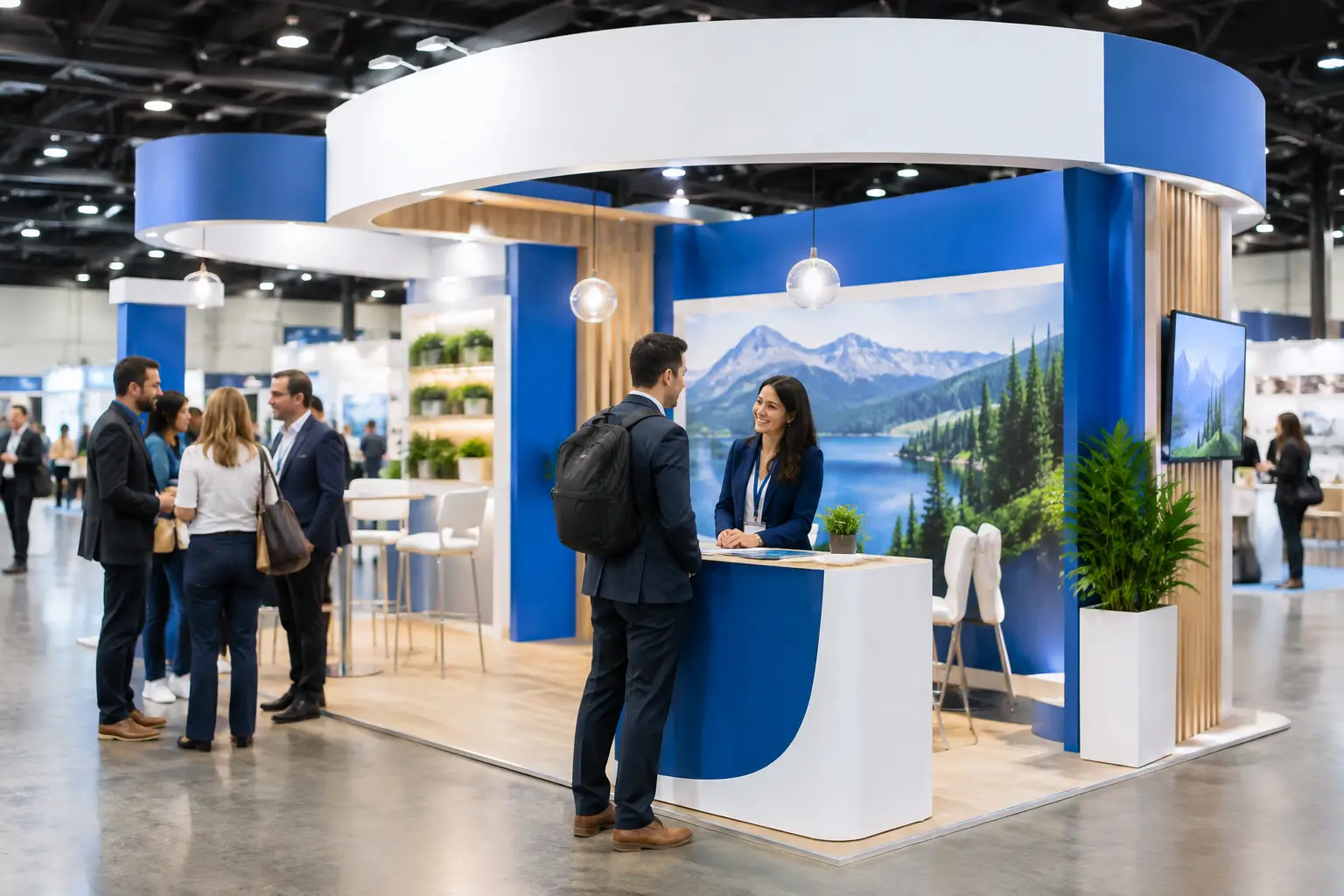
A trade show floor gives attendees seconds to decide where to stop. The strongest trade show booth branding ideas do more than make a space look polished. They tell visitors who you help, why they should care, and what to do next before the conversation even begins.
For a small business, growing company, or public-sector organization, that clarity can be the difference between a booth that feels busy and one that produces qualified conversations. A good booth does not need the largest footprint or the flashiest giveaway. It needs a focused message, consistent visual cues, and an experience that makes your brand easy to remember after a long day on the exhibit floor.
Start With One Message Visitors Can Repeat
A booth is not a brochure wall. When every service, product feature, mission statement, and credential competes for attention, visitors have to work too hard to understand you. Most will keep walking.
Choose one primary message for the event. It should answer a practical question: What outcome can attendees expect from working with you? A technology support provider might lead with, “Reliable IT support for growing teams.” A government contractor may focus on a specific capability or service area. A manufacturer could center its display on a measurable performance advantage.
Put that message at eye level, in large type, with enough contrast to read from the aisle. Your company name and logo matter, but a logo alone rarely gives a stranger a reason to engage. Pair brand recognition with a clear value proposition.
Then decide what supporting information belongs in the booth. Two or three proof points are often enough. Think certifications, years of experience, response times, customer results, or a concise list of core services. The rest can live in a handout, a screen presentation, or a follow-up conversation.
Build Trade Show Booth Branding Ideas Around Recognition
Consistency creates trust, particularly for organizations that serve multiple audiences or offer a broad range of services. If your website, sales materials, staff apparel, event signage, and giveaways feel like they came from different companies, the booth may appear less established than your business actually is.
Start with the visual foundations: logo usage, primary colors, typography, image style, and tone of voice. Use your strongest brand color to create visibility, but do not use color merely because it is part of the brand kit. High-traffic exhibit halls can be visually noisy. A deep color with white lettering may read well from a distance; a light color with thin text may disappear under overhead lighting.
Photography and graphics should also earn their space. Generic stock images can fill a wall, but they seldom explain what makes an organization distinct. Original images of your team, products in use, local projects, or real work environments make the brand more believable. For organizations that cannot show client work publicly, clean illustrations, process diagrams, or outcome-focused graphics can be more effective than decorative imagery.
A helpful test is to stand 15 feet away from a proposed backdrop. Can someone identify your organization, understand the main benefit, and recognize one relevant visual cue? If not, simplify it.
Give Every Surface a Job
Each physical element of the booth can reinforce the message without repeating it word for word. Back walls establish the promise. Counter wraps can display a short proof point or a call to action. Tabletop signage can explain a demonstration. Staff badges can make names and roles approachable.
Floor graphics, hanging signs, and lightboxes can be useful in larger exhibits, but they are not automatically better. They add cost and setup considerations. In a compact 10-by-10 space, a well-designed backdrop, branded table cover, and one purposeful display may create a cleaner impression than several competing signs.
Make the Booth Useful, Not Just Attractive
Attractive booths draw eyes. Useful booths start conversations. Consider what your ideal attendee is trying to solve at the event, then create a small experience around that need.
A software or IT services company might offer a five-minute technology readiness check. A marketing team could provide quick feedback on a visitor’s business card, homepage headline, or social profile. A packaging company might bring product samples that show how materials, finishes, and structure affect shelf presence. The point is not to give away consulting without boundaries. It is to demonstrate how your team thinks and create a natural reason to exchange information.
Interactive elements work best when they are simple. A large touchscreen can look impressive, but it may require staffing, power, reliable connectivity, and a backup plan. A tactile sample, brief assessment card, before-and-after visual, or short live demonstration can be more dependable. Choose the experience that your team can deliver confidently throughout the show.
For government and business audiences, credibility is often more persuasive than novelty. Clearly displayed certifications, compliance knowledge, service coverage, project methodology, or procurement readiness may matter more than a game or prize wheel. The right choice depends on the audience and the event’s purpose.
Bring Your Team Into the Brand Experience
Your people are the most visible part of the booth. Their approach should match the promises on the walls. A booth that says “personal support” but has staff absorbed in phones sends a conflicting message.
Before the event, agree on a short opening question that feels helpful rather than scripted. “What brought you to the show?” is flexible. “Are you looking to improve visibility, technology, or operations this year?” can work for a full-service provider with several relevant solutions. Train staff to listen for the attendee’s priority before explaining everything the company does.
Branded apparel should be coordinated and comfortable enough to wear for a full day. It does not have to be identical uniforms. A consistent color, embroidered logo, name badge, or branded outer layer can create cohesion while allowing team members to remain themselves.
Also decide how leads will be documented. Notes about a visitor’s challenge, timeline, and requested follow-up are more valuable than a stack of scanned badges with no context. Whether you use a lead retrieval app, CRM form, or simple qualifying worksheet, make the process quick enough that it does not interrupt the conversation.
Choose Giveaways People Will Keep
Promotional products can extend your booth branding beyond the exhibit hall, but only when the item is relevant, usable, and aligned with your positioning. A low-cost trinket may generate traffic, yet it can attract people interested only in freebies. That may be acceptable for broad awareness campaigns, but it is less useful when your team needs meaningful business conversations.
Consider the audience’s workday. A well-made notebook, cable organizer, reusable drinkware, desk accessory, or travel item can provide repeated brand exposure. For an industry-specific event, a practical tool connected to the attendee’s role may be even stronger.
Keep the imprint clean. Include the logo, a readable website or phone number if appropriate, and perhaps a short message. Cramming every service into a tiny product usually makes the branding harder to read. A giveaway should prompt recognition, not become a miniature catalog.
Design for the Follow-Up Before the Show Opens
The booth experience should lead somewhere. If an attendee is interested, what is the next easy step? It might be scheduling a consultation, requesting a quote, receiving a tailored resource, joining a product demo, or taking a short assessment.
Use one primary call to action and make it visible. QR codes can support that action, but they should never be the only way to engage. Include a plain-language instruction beside the code, such as “Scan to book a 15-minute planning call” or “Scan for the event-only service checklist.” Test the landing page on a mobile phone before printing anything, and make sure it carries the same visual identity and message as the booth.
Follow up while the conversation is still fresh. Refer to the specific challenge the attendee shared instead of sending a generic post-event email. This is where a consistent brand experience pays off: the message they receive should feel like a continuation of the interaction, not a new sales pitch from an unfamiliar company.
A Better Booth Starts With the Right Priorities
Budgets, booth sizes, and event goals vary, so there is no single display formula that fits every exhibitor. A first-time 10-by-10 booth may need clear signage and trained staff more than expensive custom construction. A company attending several events each year may benefit from modular displays and reusable branded assets. The best investment is the one that supports your message, audience, and follow-up process without stretching your team too thin.
At OneStop Northwest, we see branding work best when every detail supports a business purpose. Start with the conversation you want to have, then build the booth around making that conversation easy to begin. When visitors can quickly understand your value and feel confident approaching your team, the booth becomes more than an event display. It becomes a practical extension of your brand.