

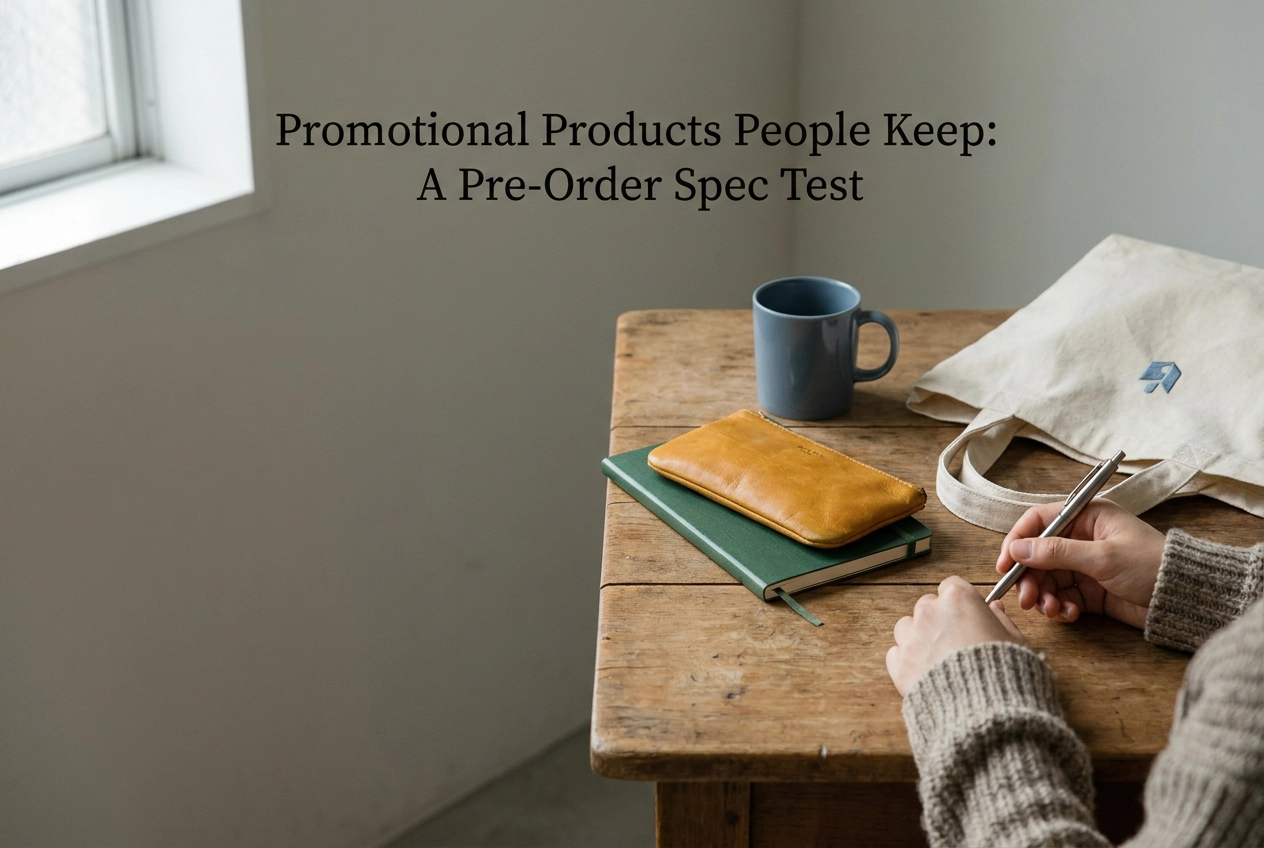
Most promotional products do not fail at the event. They fail later, in a drawer, a glove box, or a junk bin, because they never earned a place in daily use. A promotional products custom order should be planned as a utility test, not a hunt for the trendiest item. Before you commit budget, you need to know what makes a branded item survive past the event and keep working for your organization.
This tutorial gives you a pre-order spec test you can run with your team and hand to procurement. You will see why branded items end up in a drawer, learn the three questions to ask before you order, and work through three criteria: whether the item solves a problem the recipient already has, whether you can name the occasion it will be used, and whether your logo will read at the size it will actually be seen. We will also cover material, size, and decoration placement for useful life; the cost math behind buying fewer, better items; and a pre-order checklist. OneStop Northwest helps organizations in Shelton, Mason County, Western Washington, Washington State, and the Pacific Northwest, plus clients nationwide, simplify purchasing across branded merchandise, apparel, company stores, printing, signage, and fulfillment. Start with the drawer you already have.
Why Branded Items End Up in a Drawer
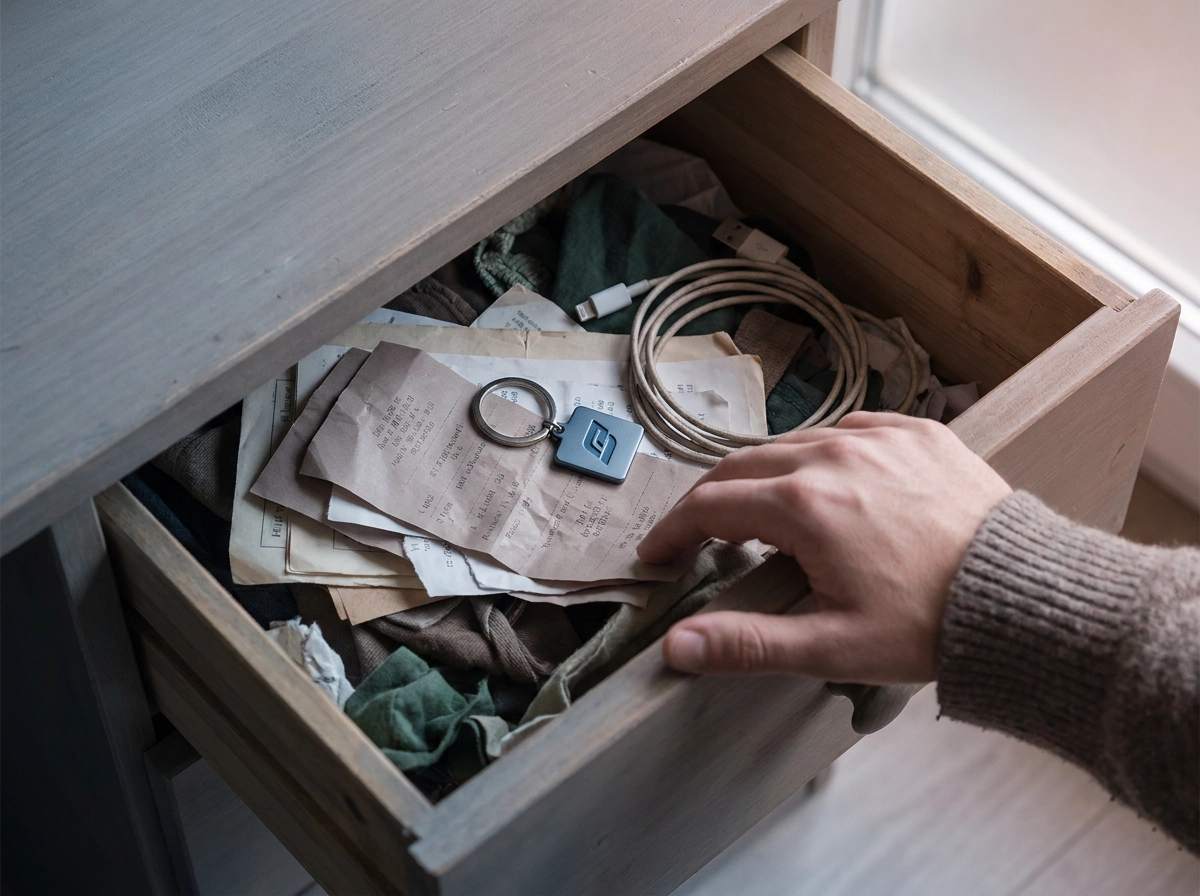
Open the drawer. Under last year’s receipts is a giveaway you took home and never used. The useful question isn’t why promotional products fail as a category. It’s why that specific item landed there, because the answer usually sits on your spec sheet.
PPAI’s 2025 5-Second Impact study, an online survey of 1,000 U.S. consumers, describes a five-second rule: a branded item has about five seconds to earn a place in someone’s life or go in the trash. Treat that carefully. The study comes from the industry’s trade association, and its figures are sponsor-funded, self-reported stated preference, not measured retention.
Those numbers still point somewhere useful. 89% of respondents said design influences whether they keep an item, which makes keeping a spec-sheet outcome rather than a product-category lottery. When items feel cheap, 62% blame poor material or build quality and 38% blame boring or generic design. Both complaints are settled before the order ships.
Redundancy does the rest. 37% said they already had too many similar items, and 13% said the item didn’t match the event or situation. The drawer fills up before the recipient even opens it. That is the starting point of a buyer’s framework for choosing promotional products people actually keep: fewer items, specified better.

The Keep Test: Three Questions to Run Before You Order
The drawer diagnosis points to a pre-order gate. The three questions are: does it solve a problem the recipient already has, can you name the occasion when they will use it, and will your logo read at the size it will actually be seen? All three need a yes.
Treat the test as a gate, not a score. Two out of three is usually a drawer item with a good story attached; change the item rather than round up. Run them in the order that saves the most work. Occasion first, because it sets quantity, timing, and decoration. Usefulness second, because it eliminates whole categories quickly. Logo legibility last, because it is the cheapest thing to fix.
Apply the test to every line, including cheap filler items and personalized promotional products handed out individually. The unit nobody scrutinized is the one that ends up in the trash.
Write the answers on the requisition or purchase request. One short line per item makes the rationale portable to a finance or procurement reviewer who was not in the planning meeting. Before a large run, review promotional products with your logo: what to know before you order so the decoration decision gets the same scrutiny as the item.
Criterion 1: Does It Solve a Problem the Recipient Already Has?
Usefulness is the strongest keep reason in PPAI’s 2025 5-Second Impact study: 68% kept an item because it was something they would actually use, and 68% credited high-quality materials for making it feel premium. The recipient is asking whether the item solves a problem they already have and will keep solving it.
Anchor that question before your brand arrives. Does it warm cold hands at a fall event, charge a dead phone on a jobsite, keep a badge dry, organize a full purse, cut glare, or catch keys in a bag? If it requires a new habit, you created a problem instead of solving one.
Quality is part of usefulness, not a separate virtue. An item that frays, leaks, or quits in a week delivers a small negative impression every time it is seen, and 62% of consumers link poor material to items that feel cheap. That includes how it arrives; custom packaging as a brand asset can protect the product and support perceived quality.
Give the item a second life. A sturdy notebook, a working cable, or a bag that survives a grocery run keeps the brand in circulation after the event. Sentiment can help: 52% said they keep items for memory value, but that value comes from the relationship and moment, not the spec sheet. Treat it as a bonus, not a reason to accept a weaker item.
Criterion 2: Can You Name the Occasion It Will Be Used?
Usefulness answers whether an item has a job. Occasion answers where and when. Fit is the thinnest signal in PPAI’s 2025 study, where 13% of consumers said an item did not match the event or situation. Treat that as directional, not as proof of how much retention misfit costs.
The operational value sits in a single sentence you should say out loud: this person will use this item, in this place, at this time, and that is why we are handing it to them. If the sentence needs a qualifying clause to hold together, the fit is weak.
Occasion also sets quantity. A one-day conference item is consumed that day. A year-round desk item must survive until March, and the two should not share a spec. When the same items get reordered year after year, it is worth knowing when an online company store beats a bulk promo order.
It sets decoration too. One product ordered for a hiring fair, a safety milestone, and a customer appreciation event should not carry the same message; customized promotional products that ignore the occasion read as leftovers.
If you cannot name the occasion, say so plainly: the item is brand awareness for your organization, not a tool for the recipient. That is a legitimate goal, but it should lower your spend per unit and your quantity.
Criterion 3: Will Your Logo Read at the Size It Will Actually Be Seen?
Once the occasion is clear, the last test is physical. Branding restraint pays: 44% of consumers prefer subtle branding, while 26% say overly large or bold branding makes an item feel cheap or forgettable and 25% blame too many logos or messages on the same item (PPAI). Check the proof at the distance that matches use. Hold an actual-size proof at arm’s length for a wearable or desk item and at three feet for anything viewed across a room. If the logo is not doing its job there, resize or reposition it.
Put the mark where the hand and eye already land: a bottle’s natural display area, a notebook cover, a chest hit, a bag panel. Two small placements on a well-designed item usually beat one panel-sized logo wrapped around an awkward curve. Keep the decoration list short: primary logo, perhaps one secondary mark, nothing else. Taglines, URLs, QR codes, and department names crowd the imprint and push the main brand toward that 26% complaint. Settle which logo version you will use before proofing; these Frequently Asked Questions about Logo Design can help standardize the choice.
Recall is already high. In PPAI’s study, 61% remembered the brand from their most recent item, 77% looked it up afterward, and 72% purchased because of a promotional product. None of that argues for a bigger logo. Oversized branding is a documented reason items feel cheap or forgettable.
Spec for Useful Life: Material, Size, and Decoration Placement
Placement settled, the question becomes whether the item lasts long enough to be seen.
The available research contains no measured useful-life data by material, size, or category, so treat these as decisions, not benchmarks. Ask what the item is made of, how it gets cleaned, and what happens at the seam, hinge, lid, or print area after a few months of use.
Match material to the occasion: dishwasher-safe for kitchen items, heavy gauge for jobsites, water-resistant for outdoor events, soft-touch for anything pocketed next to a phone. Material is a promise about the next six months, not a spec sheet line. The same durability logic applies to material specification for long-term outdoor installations.
Size the item to where it lives: a tumbler must fit a cup holder, a bottle a bike cage, a notebook a bag, a flashlight a glovebox. Oversizing to fit a bigger logo sends it home, one step from the drawer.
Decoration method belongs in the same conversation: confirm imprint dimensions, the method the supplier will actually run, and how ink or thread reads on that product color rather than the swatch.
Request an actual-size proof or sample before a large run, then use low or no minimums to test two candidates. OneStop Northwest’s supplier network and low minimums on many items make small test runs practical, and a tested item beats a bigger run of an unknown.
Buy Fewer, Better: The Cost Math Buyers Rarely Run
Good specs only pay off if the quantity is right. In PPAI’s 2025 study, 37% of consumers said they already had too many similar items. Redundancy is one of the most common stated reasons an item never gets used, and it is entirely within the buyer’s control.
Change the denominator. Most buyers divide order cost by units ordered. The useful number is cost per unit kept. Compare a $9 item kept by most recipients against a $3 item kept by a few. Hypothetically:
| Unit cost | Realistic keep rate | Cost per kept item | | $9 | 80% | $11.25 | | $3 | 20% | $15.00 |
That table is the internal argument. It does more in a budget conversation than any description of quality, and it lets procurement defend the smaller, better order. Fewer, better items also cut leftovers nobody wants to store at fiscal year-end, plus shipping and handling on volume you did not need.
Redundancy often hides across departments and locations, where three teams order three similar drinkware items in one quarter. Audit what is already in stock annually, and use a company store or fulfillment program to keep inventory visible. The same pattern shows up in apparel; a managed apparel program keeps uniform orders from becoming repeat one-offs, and prevents the fourth version of the same product.
A Pre-Order Checklist You Can Hand to Procurement
Put the cost-per-kept-item table to work as the backbone of a one-page checklist that travels with the purchase request. Five lines, in order.
Who and when. Name the recipient group and the occasion in one sentence, such as “field crews at the June safety stand-down,” and attach it to the requisition so the rationale travels with the spend.
Problem and proof. Confirm the item solves a named, pre-existing problem, and that someone on the team has handled a sample rather than only a catalog photo.
The spec line. Record material, cleaning method, dimensions, and the exact imprint area with placement, plus a restraint rule for how many elements may appear.
The math. State the quantity derived from the occasion and a realistic keep rate, then show cost per kept item next to the per-unit price.
The source note. Cite every statistic and label it as PPAI-sponsored consumer survey data, so no reviewer mistakes stated preference for measured results.
Then add a recurring line: review the whole program once a year for duplicates across departments and locations. Where apparel is in scope, the Corporate Apparel Buying Guide for HR and Operations Leaders applies the same discipline to vendor evaluation.
Start With the Drawer You Already Have
Before you file that checklist, walk to the supply closet. Empty one drawer, table, or shelf and count what came back. The survivors tell you more about your audience than any trend report, and they are usually the plain, sturdy, useful ones: a notebook that still lies flat, a cable that still charges, a bottle that still seals.
Run the three questions on your next order: does it solve a problem they already have, can you name the occasion, will the logo read at the size it will be seen? Fail one and change the item.
Write the spec down: material, cleaning, dimensions, imprint area, placement, quantity, and cost per kept item. That document is what makes a smaller, better order survive a budget review.
If consolidating scattered orders across departments or locations sounds like the harder half of the problem, OneStop Northwest in Shelton, Washington helps organizations across the Pacific Northwest and nationwide manage custom promotional products, company stores, and fulfillment through one partner. Useful first, promotional second: start with the drawer.
Conclusion

The useful items win. Run the keep test before you order: solve a problem the recipient already has, name the occasion, and make sure your logo reads at the size it will be seen. Then write the spec down: material, cleaning, dimensions, imprint area, placement, quantity, and cost per kept item, so a smaller, better order can survive procurement review. Review the whole program once a year for duplicates across departments and locations. Where apparel is in scope, the Corporate Apparel Buying Guide for HR and Operations Leaders applies the same discipline to vendor evaluation. Your next step: empty one drawer, count what came back, and run the checklist on your next order. If scattered orders across departments or locations are the harder half, OneStop Northwest in Shelton, Washington can help manage custom promotional products, company stores, and fulfillment through one partner. Useful first, promotional second: start with the drawer.
Frequently Asked Questions
Why do most promotional products end up in a drawer instead of being used?
Most promotional products fail after the event because they never earn a place in daily use. PPAI's 2025 5-Second Impact study (a sponsor-funded, self-reported survey of 1,000 U.S. consumers) found that 37% of respondents already had too many similar items and 13% said the item didn't match the event or situation. The post recommends treating the item's specification as the cause, since the reason a specific item lands in a drawer usually sits on the spec sheet.
What three questions should I ask before ordering promotional products?
Run three questions as a pre-order gate: (1) Does the item solve a problem the recipient already has? (2) Can you name the occasion when they will use it? (3) Will your logo read at the size it will actually be seen? All three need a yes. Two out of three usually means you should change the item rather than round up. The post suggests asking about the occasion first, usefulness second, and logo legibility last.
How do I tell if an item solves a problem the recipient already has?
Anchor the question before your brand arrives: does the item warm cold hands at a fall event, charge a dead phone on a jobsite, keep a badge dry, or catch keys in a bag? If it requires a new habit, it creates a problem instead of solving one. In PPAI's 2025 study, 68% kept an item because they would actually use it. Quality is part of usefulness, since 62% of consumers linked poor material to items that feel cheap.
How should I decide where and how big to put my logo?
Check the proof at the distance that matches use: an actual-size proof at arm's length for a wearable or desk item, and at three feet for items viewed across a room. Place the mark where the hand and eye land, such as a bottle's display area, a notebook cover, a chest area, or a bag panel. Keep the decoration list short: a primary logo, perhaps one secondary mark, and nothing else. In PPAI's study, 44% preferred subtle branding, while 26% said overly large or bold branding made items feel cheap or forgettable.
How do I compare the true cost of promotional items?
Use cost per kept item rather than cost per unit ordered. The post's hypothetical example shows a $9 item with an 80% keep rate costs $11.25 per kept item, while a $3 item with a 20% keep rate costs $15.00 per kept item. The post presents these as hypothetical figures to illustrate the method. Buying fewer, better items also reduces leftover inventory and unneeded shipping and handling.