


Every organization that orders company branded merchandise more than once or twice a year eventually hits the same wall. Someone needs to reorder polos for a new hire class, another team wants branded tote bags for an event, and suddenly you’re juggling multiple vendor quotes, chasing down logo files, and manually approving orders that probably should have shipped last week.
At that point, a natural question surfaces: is there a better system for this?
The two most common answers are bulk promotional ordering and a managed online company store. Both work, but they work for different situations, and choosing the wrong one can cost you more than just money. It can cost you time, consistency, and inventory you’ll never actually use.
This post breaks down exactly how each model operates, where the real cost differences live, and how to figure out which approach makes sense for your organization right now. No assumptions, no jargon, and no pressure toward a one-size-fits-all answer. Just a practical framework you can actually use the next time someone asks, “So how are we handling merch this quarter?”
Two Purchasing Models, One Practical Question
Most organizations that buy branded merchandise have never formally compared their options. They find a supplier, place an order, and repeat. The question of whether a better approach exists never quite gets asked.
This piece is built around that question.
The two purchasing models are straightforward. A bulk promotional products order is a one-time or periodic purchase: you identify a need, source the items, approve artwork, and receive a fixed quantity. A managed online company store is a standing portal where employees, departments, or locations order pre-approved branded products on demand, with catalog management, supplier relationships, and fulfillment handled behind the scenes.
Neither model is inherently better. The right fit depends on how often your organization orders, how many people are involved, and how much administrative capacity you are spending to manage the process today.
That last part matters more than most buyers realize. Many organizations default to bulk ordering because it is familiar, not because they have weighed it against the alternative.
A 12-person agency has different branded merchandise needs than a 400-person healthcare network or a hospitality group managing multiple properties. Tradeoffs that look minor at small scale can create real operational friction as complexity grows, which is why the conversation around managed apparel programs versus one-off uniform orders often mirrors this one closely.
What follows is a practical evaluation of both models.
How Bulk Promo Ordering Actually Works

Most bulk promotional products orders follow the same sequence: someone identifies a need, digs up the artwork files (hopefully the right version), finds a supplier or distributor, works through quantities and pricing, reviews proofs, and waits for production and delivery. It’s a manageable process. It just restarts from scratch every single time.
One persistent friction point is the minimum order quantity. Suppliers often require organizations to order more units than they actually need to hit a price break worth taking. The result is a storage closet with more branded items than the original need called for. That excess inventory ties up budget and, more often than not, eventually gets thrown away.
That said, bulk ordering is genuinely the right fit in a number of situations: a large one-time event where the quantity is fixed in advance, a product launch campaign with a defined window, or a newer organization still figuring out which branded items it actually wants to standardize around. For organizations that order corporate branded merchandise once or twice a year with predictable quantities, the process works fine.
The complications build when bulk ordering becomes a recurring habit. Setup fees repeat with each new order. Different staff members pulling together separate orders often pull different logo files, which creates version drift across apparel and printed materials. And the staff time spent re-sourcing, re-proofing, and re-reconciling each cycle is real overhead, even if it rarely appears as a line item on anyone’s budget.
How an Online Company Store Works
A company store flips the bulk order model on its head. Instead of launching a sourcing project every time someone needs branded gear, you build a single portal where pre-approved products are already loaded, artwork is locked in, and authorized users place an order when they need something.
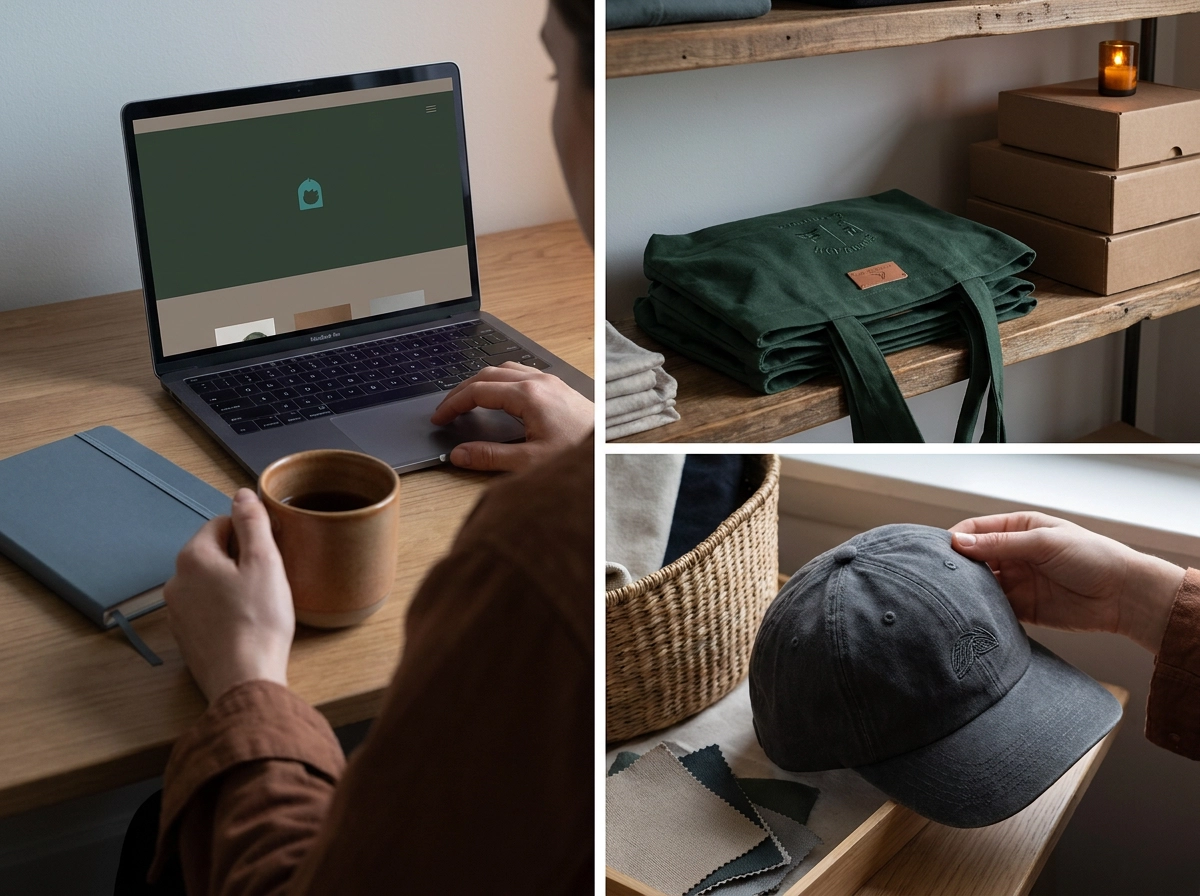
That portal sits on a managed platform, which matters more than it sounds. Catalog maintenance, supplier relationships, inventory management, and fulfillment logistics are handled on the back end, not by whoever in your organization drew the short straw. Your team clicks, orders, and receives.
The range of applications is broader than most people expect. A single program can support employee onboarding kits, department uniform programs, promotional products for regional sales teams, customer-facing merchandise, and multi-location ordering, all under one roof. HR, marketing, and operations each access the same store without coordinating through a single bottleneck.
A persistent misconception: company stores are not just for large enterprises. Managed solutions scale to fit organizations of different sizes and ordering volumes. If you are curious how this structure compares to other portal types, this breakdown of company stores, team stores, and employee portals is worth a few minutes.
The most underrated benefit is brand governance. When artwork and product specs are locked into the catalog, the version drift that plagues organizations where multiple people independently place orders, each pulling a slightly different logo file, simply stops happening.
Where the Cost Difference Actually Lives
So where does the company store actually earn back its cost? It comes down to four places most organizations undercount.
Overstocking. Bulk orders require hitting a minimum quantity, which means ordering more than you need and hoping the rest gets used. On-demand or small-batch fulfillment lets you order closer to actual demand rather than anticipated demand.
Supplier relationships. A managed program maintains standing supplier relationships, which produces more stable pricing than a series of one-off transactions.
Administrative labor. Every independent bulk order requires someone to track down a supplier, dig up artwork files, review proofs, follow up on delivery, and reconcile the invoice — overhead that a managed store converts from a recurring project into a recurring system.
Brand consistency. Off-logo colors, outdated artwork, and embroidery that doesn’t match brand standards aren’t just cosmetic problems; fixing or replacing those items costs real money. A locked catalog removes the conditions that create those errors.
None of this follows a universal formula. Whether these savings outweigh the cost of a managed program depends on your organization’s ordering volume, frequency, and what your internal labor actually costs. Rather than taking anyone’s word for it, pull your last 12 months of ordering activity and map it against these four categories. Many organizations find they’re further into company store territory than they expected.
Signs a Company Store Is Worth the Investment
Those cost categories become most visible when you recognize the patterns in your own organization. If any of the following sound familiar, a managed company store is worth a serious look.
You’re placing orders more than three or four times a year. Each order placed as a standalone project carries its own full administrative load. Multiply that across departments, locations, or seasonal occasions and the cumulative time adds up fast.
Multiple people are placing orders independently. When HR orders onboarding kits, marketing orders event materials, and individual locations order uniforms separately, a shared portal with pre-approved products prevents both duplicated effort and brand inconsistency.
You onboard employees regularly. Organizations with steady hiring or meaningful turnover need branded apparel and welcome kits available on demand, not queued up in a periodic bulk run. A self-service portal means new hires aren’t waiting and no one has to manually trigger a reorder.
You operate across multiple locations. Schools, healthcare networks, hospitality groups, and public safety departments with multiple sites frequently end up with inconsistent branded merchandise when each location manages its own ordering. Understanding what branded merchandise benefits teams can look like across distributed operations helps frame what you’d actually be solving.
Your finance team is chasing scattered invoices. Consolidated invoicing, spending controls, and order history in one place give procurement and finance far better visibility than a stack of one-off vendor bills.
Your staff already describes the process as frustrating. That friction is a reliable signal. If reordering feels like starting from scratch every time, a managed system would recover real hours.
Signs Bulk Ordering Is Still the Right Call
Of course, not every organization fits the profile described above, and that is completely fine.
If your organization orders branded merchandise once a year for a single event or seasonal campaign, there is no meaningful case for building a managed portal around that activity. The infrastructure would cost more in time and setup than the ordering problem it solves.
The same logic applies when each order looks completely different. If this year’s order is trade show giveaways, next year’s is safety vests, and the year after that is custom packaging for a product launch, a curated catalog does not map well to that reality. A company store works best when there is predictable, repeating demand for a defined set of products.
Small, stable organizations with a single location, steady headcount, and no distributed ordering needs often do just fine with a direct supplier relationship and one or two annual orders. Simple situations deserve simple solutions.
One-time campaigns and event-specific runs are also natural fits for direct bulk ordering. When quantity, timing, and product specs are all fixed in advance, a structured portal adds overhead without adding value.
Bulk ordering is not a fallback for organizations that cannot afford something better. It is the right tool for specific situations, and treating it that way is what good planning actually looks like. If your ordering patterns match any of the above, a direct supplier relationship and a straightforward bulk order is likely the right starting point.
A Practical Framework for Making the Call
If bulk ordering fits your situation, you already have your answer. If you’re still not sure, a few honest questions about the past year can help clarify things.
Start with a simple count. How many separate branded merchandise or promotional products orders did your organization place in the last 12 months? Include orders from different departments, locations, or event-driven needs, not just the ones you personally managed. If that number surprises you, that’s useful information.
Then ask who was involved. How many different people placed or approved those orders? Every independent decision-maker added to the process is another opportunity for brand inconsistency and duplicated administrative effort. One person ordering quarterly is a different situation than five departments ordering independently on their own timelines.
Look at your storage closets. Did the last several orders result in leftover product? Overstocked branded merchandise is a real recurring cost — see the cost breakdown above for why it adds up.
Check for version drift. Has your organization had old logo versions or wrong color specs show up on items from different teams? That’s a brand consistency problem with a practical fix.
If you answered yes to two or more of those, it’s worth a conversation with a managed Brand Solutions partner to understand what a program would actually look like for your specific situation, and what it would cost.
This isn’t a formula. It’s a starting point. The right answer depends on details that vary by organization, and a knowledgeable partner can help you work through them without pressure to commit before you’re ready.
What to Look for in a Managed Company Store Partner
Once you’ve decided a managed company store makes sense, the next question is what to look for in a provider.
Start with operational scope. Some platforms give you a storefront and leave the rest to you: catalog setup, artwork files, supplier coordination, fulfillment logistics. A true managed solution handles all of that on your behalf. If a provider’s pitch stops at “here’s your portal,” that is a platform sale, not a managed program.
Ask whether the program supports both on-demand ordering and periodic restocking within the same store. Most organizations need both. Employees ordering branded apparel on their own schedule is different from a quarterly uniform refresh, and the right partner handles each without requiring a separate process for every scenario.
Brand standards enforcement matters more than most buyers anticipate. Confirm the partner owns the embroidery specs, approved print files, and color matching for every catalog product, so your team is not manually reviewing orders or chasing logo versions after the fact.
For organizations that need apparel, promotional products, printed materials, and signage, ask directly whether one partner can manage all of those categories or whether the store will require multiple vendor relationships running behind the scenes. If you need guidance on the print side, understanding how offset, digital, and wide-format printing each fit different project types is useful groundwork before that conversation.
OneStop Northwest builds and manages company stores as part of a broader single-source program covering branded apparel, promotional products, printing, and fulfillment under one relationship, removing the vendor coordination work that platform-only solutions leave with the client.
The Bottom Line: Match the Model to the Reality
Neither model is universally better. The right choice comes down to how often your organization orders, how many people are involved, and what that scattered administrative work is actually costing you in time and budget.
For organizations placing branded merchandise orders multiple times a year across departments, locations, or occasions, a managed company store can often recover its cost over time.
Before assuming a company store is too complex or too expensive for your situation, do one honest exercise: count how many separate orders your organization placed in the last 12 months, who placed them, and how much leftover inventory you have to show for it. That number tells you more than any general framework can.
If the count surprises you, it’s worth a conversation. OneStop Northwest works with organizations of all sizes to figure out which model actually fits, and if a managed store makes sense, what that would look like in practice. No pressure, no assumptions. Just a straightforward conversation about what works for your situation.
Conclusion

Choosing between bulk ordering and a managed company store is not about which model sounds better on paper. It comes down to your actual ordering patterns, how many people are involved, and what inefficiencies are quietly draining your budget and staff time.
Count your orders from the last 12 months and let that number guide the conversation. OneStop Northwest is ready to help you find the model that fits.
Frequently Asked Questions
What is the main difference between bulk promotional ordering and a managed online company store?
Bulk promotional ordering is a one-time or periodic purchase where you identify a need, source items, approve artwork, and receive a fixed quantity. A managed online company store is a standing portal where employees and departments order pre-approved branded products on demand, with catalog management, supplier relationships, and fulfillment handled behind the scenes. The key difference is that bulk ordering restarts from scratch each time, while a company store provides ongoing, self-service access to pre-approved products.
How much excess inventory does bulk ordering typically create?
Bulk orders often require hitting minimum order quantities set by suppliers, which means organizations must order more units than they actually need to hit favorable pricing. This excess inventory typically ties up budget and often gets thrown away rather than used, representing real recurring costs that many organizations don't properly account for in their purchasing decisions.
What are the four main cost areas where a managed company store can save money?
The four key cost-saving areas are: (1) Overstocking—ordering closer to actual demand rather than anticipated demand, (2) Supplier relationships—maintaining standing supplier relationships that produce more stable pricing than one-off transactions, (3) Administrative labor—converting recurring sourcing, proofing, and reconciliation work into a system rather than a project, and (4) Brand consistency—eliminating off-logo colors, outdated artwork, and embroidery errors that cost money to fix or replace.
How many orders per year indicate that a managed company store might be worth the investment?
Organizations placing orders more than three or four times per year should seriously consider a managed company store. Each standalone order carries its own full administrative load, and when this is multiplied across departments, locations, or seasonal occasions, the cumulative time and cost adds up quickly. If you're uncertain, count your actual orders from the last 12 months to see if the number surprises you.
When is bulk ordering still the right choice for an organization?
Bulk ordering remains the best fit when: (1) your organization orders branded merchandise once a year or less for a single event or seasonal campaign, (2) each order looks completely different with unpredictable product needs, (3) you have a small, stable organization with a single location and no distributed ordering needs, or (4) you're running a one-time campaign or event with fixed quantity, timing, and product specs. Simple situations deserve simple solutions, and bulk ordering is the right tool for these specific scenarios.