

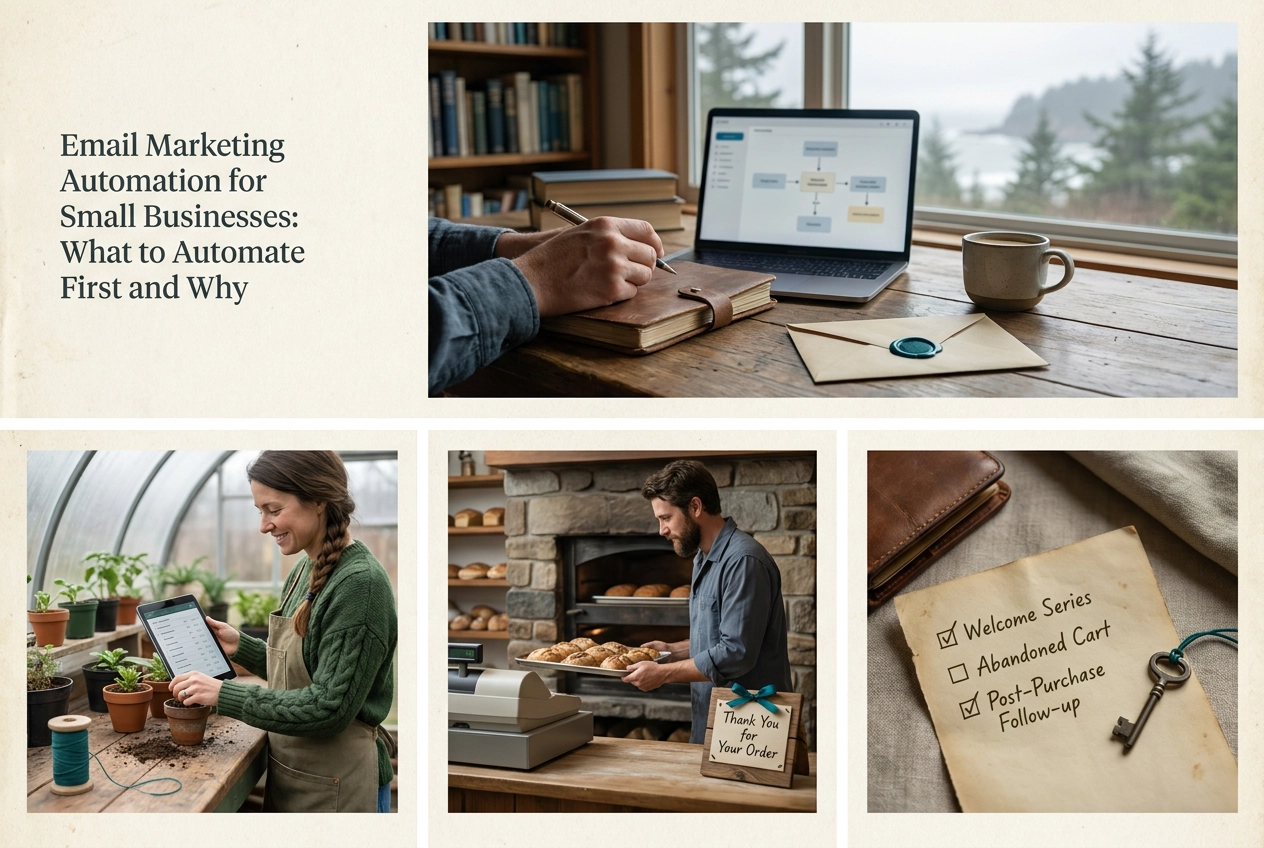
You already know email marketing works. With $36 back for every $1 spent, it outperforms virtually every other channel available to small businesses. So why does it still feel like such a grind?
For most small business owners, the answer comes down to doing it manually. You write a campaign, hit send, and then wait. You do it again next month. It works well enough, but it never quite feels like it’s working for you.
That’s exactly what email marketing automation is designed to fix. Instead of reacting, you set up smart sequences that run in the background, welcoming new subscribers, winning back inactive ones, and turning first-time buyers into loyal customers, all without you lifting a finger each time.
The tricky part is knowing where to start. With so many platforms and so many possible workflows, it’s easy to get overwhelmed and do nothing at all.
This guide cuts through that noise. You’ll learn which three sequences deliver the fastest results, what to look for in automation software, and how to build a foundation you can grow without needing a developer or a big budget.
Why Email Automation Outperforms Manual Sending
Yet most small businesses are capturing only a fraction of that potential, and the gap comes down to one thing: automation versus manual sending.

Roughly 70% of companies still rely on batch-and-blast campaigns, scheduling a newsletter, writing a subject line, and hitting send to their entire list on a recurring schedule. That approach produces average open rates below 15% and click-through rates under 2%. Businesses running behavior-based automation see open rates above 40% and CTRs of 6 to 8%. The difference is not budget or team size; it is timing and relevance.
About 86% of small businesses send email at least once a month, which sounds consistent until you consider what it actually means: someone remembered to send something, found time to write it, and pushed it out. That is reactive, not systematic. Calendar-driven sends treat every subscriber the same regardless of what they have done, bought, or ignored.
Automation fixes this by replacing guesswork with behavioral triggers. The email goes out because a subscriber just signed up, completed a purchase, or went silent for 90 days, not because it happened to be Tuesday. The message matches the moment.
The Three Sequences to Build First
So where do you actually start? Three sequences cover the moments that matter most in any customer relationship: the moment someone joins your list, the moment they go quiet, and the moment they buy something.
Welcome, re-engagement, and post-purchase form the foundation because they’re predictable. Every business has new subscribers, dormant contacts, and customers who’ve completed a purchase. Building automation around those three triggers first means you’re not guessing at what to build next.
The order of priority is intentional:
- Welcome sequences come first. Interest peaks the moment someone signs up. A timely, well-crafted welcome captures that momentum before it fades.
- Re-engagement sequences come second. Dormant subscribers quietly erode your deliverability, which affects every email you send. Addressing this early protects the list you’re building.
- Post-purchase sequences come third. Once the foundation is solid, this sequence deepens loyalty and creates the conditions for repeat revenue.
Starting here, rather than with complex drip campaigns, keeps the technical lift manageable for a small team. Each sequence can be built once and improved over time, which makes them the most efficient use of limited marketing bandwidth.
For organizations with long or seasonal buying cycles, such as nonprofits running annual campaigns or government procurement contacts who purchase on a set schedule, these three sequences also serve as a steady communication framework during the quiet periods between active buying windows. Much like planning design for the follow-up before the show opens, the real value comes from setting up the structure before you need it.
Those five flows account for most email revenue, and three of them are the ones every small business should build first.
The Welcome Sequence: Your First Priority
The welcome sequence comes first for a simple reason: a new subscriber is never more interested in you than the moment they sign up. That window closes fast, so your first email needs to go out within minutes, not hours.
The three-email structure is straightforward:
- Email 1 (immediate): Confirm the signup and deliver whatever you promised, whether that’s a resource, a discount, or simply a warm introduction. State clearly what they can expect from you going forward.
- Email 2 (within 48 hours): Introduce what you do and how you help. This is context-setting, not a sales pitch.
- Email 3 (within the first week): Offer a logical next step, a product category to browse, a consultation, a guide, or a relevant resource that moves the relationship forward.
For businesses managing branded apparel programs, company stores, or custom merchandise orders, this sequence does extra work. New contacts often arrive with basic questions about minimums, turnaround times, and how customization works. Answering those proactively in your welcome sequence reduces inbound support volume before it starts.
Personalization at this stage doesn’t need to be sophisticated. Using the subscriber’s first name, acknowledging how they found you, and setting honest expectations for future emails is typically enough to lift engagement at the welcome stage.
Every sequence you build later will operate within the framework this one establishes. Get the welcome sequence right first, and the rest of your automation has a solid foundation to build on.
The Re-Engagement Sequence: Protect Your List and Your Deliverability
Once your welcome sequence is in place, the next priority is protecting the list you’re building.
Inbox providers are widely understood to use engagement signals, specifically opens and clicks, as factors in sender reputation scoring. When a large portion of your list stops interacting with your emails, those providers start routing your messages to spam, affecting even your most engaged subscribers. A dormant list is not a neutral condition; it actively works against you.
A re-engagement sequence triggers automatically when a subscriber has not opened or clicked anything for an extended period, commonly defined as 60 to 90 days by platform defaults, though platform defaults vary. The sequence starts low-pressure and escalates simply:
- Email 1: A “we miss you” message that briefly recaps the value you provide
- Email 2: A reason to return, such as new products, updated services, or a seasonal offer relevant to their needs
- Email 3: A clear choice to stay subscribed or unsubscribe, with no friction either way
This structure matters especially for organizations with longer buying cycles. A nonprofit running annual fundraising campaigns, a government procurement contact who orders seasonally, or a wholesale client on a quarterly schedule may go quiet between purchases without actually losing interest. Re-engagement automation keeps those relationships warm without requiring manual follow-up.
When someone does not respond to any of the three emails, remove them. Cleaning your list is not a setback. A smaller, actively engaged list consistently outperforms a large, unresponsive one in both inbox placement and conversion, and honoring unsubscribe requests promptly is also a legal requirement under U.S. email law.
The Post-Purchase Sequence: Turn First-Time Buyers into Repeat Customers
Once a subscriber becomes a buyer, the relationship shifts. The post-purchase sequence picks up where the sale ends and keeps that momentum moving forward.
This sequence typically covers four touchpoints: an order confirmation sent immediately, a shipping notification once the order is in transit, a delivery confirmation with any relevant usage or care guidance, and a follow-up asking for feedback or a review. Each one has a job, and together they replace the silence that often follows a transaction.
For businesses selling branded apparel, promotional products, or custom merchandise, these emails do more than track a package. They’re a natural opportunity to introduce reorder reminders, highlight related products, or share information about how our promotional products process works and what ongoing fulfillment programs can look like. A customer who just ordered embroidered polos for their team is a strong candidate for a company store conversation.
Generic transactional emails get ignored. Emails that reference the specific product ordered and anticipate what the customer logically needs next earn attention and drive return purchases.
For organizations managing employee apparel programs, school spirit stores, or team stores, this sequence also handles a practical problem. Custom and decorated merchandise takes time to produce. Proactively setting those expectations in the first one or two emails reduces inbound “where’s my order?” questions before they pile up.
When connected to a CRM, post-purchase data also feeds customer lifetime value tracking, making it easier to recognize high-value accounts and reach back out before their next buying cycle begins.
What to Look for in Email Marketing Automation Software
Those three sequences address the relationship moments. The platform you build them on determines whether they actually work.
CRM integration is the single most important requirement, confirm any platform connects bidirectionally to your CRM so records stay current and sequences fire on accurate information. The key decisions around integration are covered in the following section.
No-code workflow builders are now table stakes. If a platform requires a developer to configure a basic three-email welcome sequence, it is not built for a small team. Drag-and-drop builders are standard across entry-level plans.
Native integrations matter more than feature count. Evaluate platforms against the systems you already use, whether your website, ecommerce platform, or point-of-sale system. A platform with 200 features and a clunky sync will underperform a simpler one that connects cleanly.
Behavioral triggers separate real automation from scheduled blasts. Form submissions, page visits, purchases, and inactivity should all be capable of firing a sequence. Time-based sends alone will limit you quickly.
AI-assisted features are now increasingly available at entry-level plan pricing, with send-time optimization and predictive content worth evaluating even for very small teams.
Finally, choose a platform that scales. Moving from three sequences to a full behavioral program should not require migrating your entire contact database. That consideration belongs at the start, not after you have outgrown your first tool. A well-chosen platform is foundational to the broader Key Components of a Successful Digital Marketing Strategy your business will build over time.
The Integration Mistake That Undermines Most Small Business Automation
Even the right platform will underperform if your customer data isn’t connected properly. Data silos are the most common reason email automation misfires: when your email tool doesn’t communicate with your CRM, sequences trigger based on stale or incomplete records.
This creates real problems. A promotional email goes to a customer mid-dispute. A welcome sequence fires for someone who’s been a client for two years and simply re-subscribed. An unsubscribe doesn’t get suppressed from a transactional send. Each of these erodes trust and can create compliance exposure under U.S. email law.
For businesses managing multiple contact types, such as wholesale accounts, retail customers, nonprofit partners, and government procurement contacts, a unified CRM feeding your email automation isn’t optional. It’s what ensures each segment gets messaging that actually fits their relationship with you. Learn more about avoiding fragmented records in this guide to how to integrate CRM systems without data gaps.
The practical fix happens before you select a platform. Map where your contact records currently live, what actions create or update them, and which system will serve as your single source of truth. Skipping this step is one of the most common buying mistakes teams make when adopting new marketing technology.
If you don’t have an in-house IT team, choose a platform built for integration from the start, or work with a partner who can configure the connection correctly.

When to Expand Beyond the Three Core Sequences
Once your integration is solid and your three core sequences are running consistently, that’s the right moment to think about what comes next, not before.
Expanding before those three are stable adds complexity without proportional return.
When the foundation is producing consistent results, natural expansion points include:
- Browse abandonment sequences for ecommerce businesses, triggered when a visitor views a product but doesn’t act
- Cart recovery emails for online stores, sent when a customer leaves items behind at checkout
- Lead nurture sequences for longer sales cycles, keeping prospects engaged between initial contact and a purchase decision
- Anniversary or milestone emails for relationship-based accounts, where timing and recognition matter as much as the offer
For multi-location businesses, employee apparel programs, or organizations managing multiple departments, segmentation adds meaningful value at this stage, ensuring each audience receives messaging that reflects their actual context.
A practical rule before adding any new sequence: confirm you have a clearly defined trigger, a logical message flow, and the internal bandwidth to monitor and adjust it. Build based on real customer behavior, not platform features that seem useful.
Effective marketers are significantly more likely to use automation than their less effective counterparts, but that advantage comes from sustained optimization, not just setup. Businesses at this stage often benefit from a digital marketing partner who handles ongoing A/B testing, list hygiene, and performance monitoring, so the internal team can stay focused on running the business.
Start Simple, Then Build
When you’re ready to act on everything covered here, remember the core principle: three well-built sequences will outperform a dozen half-finished ones every time. As covered earlier, those three sequences deliver measurable results before more complex programs are warranted.

The most common barrier to getting started is not budget or technical skill. It is choosing a platform that does not connect to the systems you already use. Implementing digital marketing strategies that actually work means prioritizing integration over feature count from day one.
The right starting point is the one your team can implement, maintain, and build on as your business grows. Not the platform with the longest feature list.
If managing this in-house is not realistic, that is a practical business decision, not a failure. OneStop Northwest offers digital marketing and CRM services that help organizations configure and manage email automation as part of a broader business strategy, without requiring a separate agency, platform specialist, or IT resource. Ready to streamline your customer communication? OneStop Northwest can help you build the foundation correctly and expand from there.
Start with three sequences. Connect them to accurate data. Then build.
Conclusion
If you are ready to stop sending emails manually and start building systems that work while you focus on your business, OneStop Northwest is ready to help you get there.
Frequently Asked Questions
What is the return on investment (ROI) for email marketing?
Email marketing delivers $36 back for every $1 spent, outperforming virtually every other marketing channel available to small businesses. However, most small businesses are only capturing a fraction of this potential by relying on manual, batch-and-blast campaigns instead of automation. Businesses using behavior-based automation see significantly higher open rates (above 40% vs. below 15%) and click-through rates (6-8% vs. under 2%), which directly improves ROI.
What are the three core email sequences every small business should build first?
The three foundational sequences are: (1) Welcome Sequence – sent immediately and within the first week to new subscribers to capture their peak interest; (2) Re-Engagement Sequence – triggered after 60-90 days of inactivity to protect your list's deliverability; and (3) Post-Purchase Sequence – sent after a customer makes a purchase to drive loyalty and repeat business. These three sequences cover the predictable, high-impact moments in every customer relationship and should be built before expanding to more complex automations.
How can I tell if my email automation platform is right for my small business?
Look for platforms that offer: (1) CRM integration capabilities that work bidirectionally to keep data current; (2) No-code, drag-and-drop workflow builders that don't require developer support; (3) Native integrations with systems you already use; (4) Behavioral triggers like form submissions, page visits, and inactivity detection; and (5) Scalability so you can grow from three sequences to a full program without migrating your database. Prioritize integration quality and ease of use over feature count.
Why is CRM integration so critical to email automation success?
CRM integration is essential because data silos cause automation to misfire. Without proper bidirectional CRM connection, sequences trigger based on stale or incomplete information, leading to problems like promotional emails sent during customer disputes, welcome sequences sent to long-term clients, and unsubscribe requests not being suppressed. A unified CRM ensures accurate data flows to your email platform, proper segmentation by customer type, and compliance with U.S. email law. Before selecting a platform, map where your contact records live and designate a single source of truth.
When should I expand beyond the three core email sequences?
Only expand after your three core sequences are stable and producing consistent results. Expanding too early adds complexity without proportional return. Once your foundation is solid, consider adding sequences like browse abandonment, cart recovery, lead nurture for long sales cycles, or anniversary emails based on your business type. Before adding any new sequence, confirm you have a clearly defined trigger, logical message flow, and internal bandwidth to monitor and optimize it. The focus should always be on building sequences based on real customer behavior, not available platform features.