

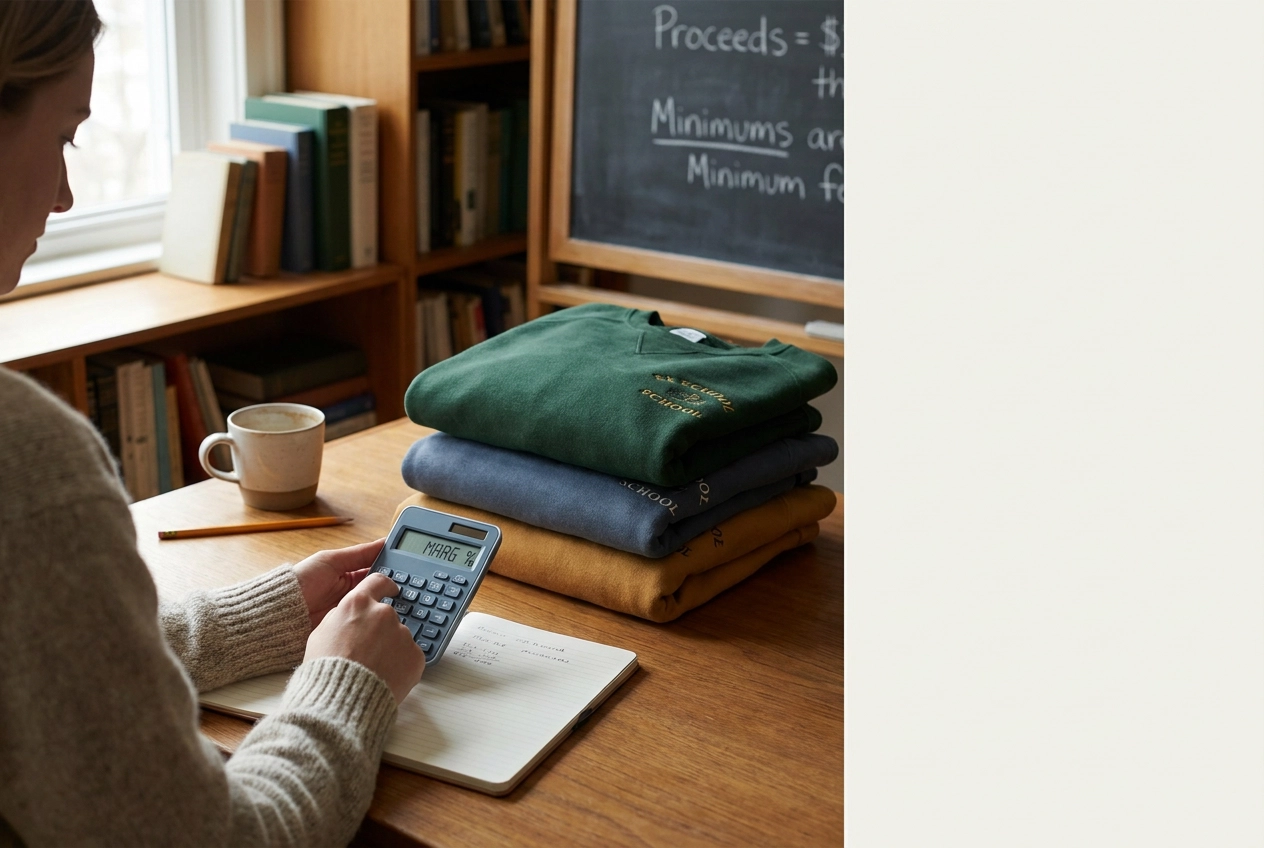
A spirit store can look like easy fundraising until the first invoice, leftover shirt, or sales tax question arrives. The amount your group actually keeps is not a mystery. It is arithmetic, and the numbers behind spirit wear for schools are easier to manage when you see how each decision affects net proceeds.
In this tutorial, we will break down what a spirit wear store for schools actually nets and review the four variables that set your proceeds: decoration setup and per-item minimums, the retail margin your group chooses, sell-through on each item, and whether the sales window closes on time. We will also walk through a worked example with 400 students, three weeks, and six designs, then look at profit levers that often work better than a price increase, Washington tax treatment for periodic versus recurring sales, and what to confirm before opening. OneStop Northwest, based in Shelton, Washington and serving organizations nationwide, supports school spirit store services and branded merchandise programs that help groups reduce vendor complexity and make more informed decisions before the next sale.
What a Spirit Wear Store for Schools Actually Nets
Gross sales is the number on the flyer. Net proceeds is what the group keeps after product cost, decoration setup, unsold inventory you already paid for, and any sales tax you must remit. That is the number that buys uniforms.
A spirit wear store for schools runs like a short retail season: you commit to inventory before demand is known, set a price, sell inside a fixed window, and absorb whatever does not move. Two groups can run nearly identical stores and keep very different amounts. The gap is usually design count, minimums, sell-through, and the closing date, not the price on the tag.
Treasurers and athletic directors already know how to sell spirit wear. What they lack is a model connecting setup charges, per-item minimums, margin, sell-through, and the deadline into one defensible number. If your group is weighing store structures, see how company, team, and employee stores differ. Every figure in the worked example below is a labeled assumption to replace with written quotes and real roster counts.
The Four Variables That Set Your Net Proceeds
Naming those inputs is the first step toward controlling them.
Decoration setup and minimums. A one-time charge per design, plus the smallest quantity a supplier will produce for each item and each decoration location.
Retail margin. The gap between your landed unit cost and the price your group sets. Landed cost includes the garment, decoration, setup share, and freight.
Sell-through. The share of each item you order that sells before the window closes. Calculate it item by item, not for the store overall, because an average hides the loser. Knowing what drives cost when ordering custom logo products helps you read each quote before you commit.
The close date. The day the store stops taking orders. It decides how much inventory you carry out of the season and, in Washington, whether the sale looks periodic or ongoing.
The four interact: lower minimums let you test items, stronger sell-through protects margin you never had to raise, and a firm close date limits the inventory you have to eat.
Variable 1: Decoration Setup and Per-Item Minimums
Setup charges follow the artwork, not the unit count. A one-color front print and a two-color front with a back print are two different bills on the same shirt, because screen charges are typically assessed per color.
Minimums usually apply per design, per item, and per color. Six designs on one style can become six separate commitments before a single unit sells.
That is why setup amortizes against units sold, not units ordered. Order 100 and sell 100 and it spreads thin; sell 60 and the same setup rides on 40 units nobody wanted.
Get the minimum in writing for every style, colorway, and decoration location before you approve artwork. Minimums shift with the product and the decoration method, so one quote does not predict another. Fewer, better designs usually cost less to set up and give families a clearer choice. The same total-cost lens applies to branded uniforms versus off-the-shelf workwear. OneStop Northwest describes its supplier network as offering low or no minimums on many items, which makes a small test run more practical for a first-year store.
Variable 2: The Retail Margin Your Group Sets
With setup and minimums pinned down, the next number is the one your group controls: margin. Here, margin means markup: retail price minus landed unit cost, expressed as a percentage of retail. Landed cost includes the garment, decoration, the setup share, and freight. Your supplier sets cost; your group sets price. Price is the variable you can still adjust after quotes arrive and before the store opens.
A higher tag raises revenue per unit but may lower units sold. If a family drops from two items to one, gross profit can fall even as the margin percentage rises. Sanity-check your target against comparable spirit wear prices in your community and decide whether the gap justifies that volume risk. Your supplier can help with pricing, but the decision is the group’s.
Finally, margin is not proceeds. Where a sale is taxable in Washington, sales tax is collected on top of the retail price and remitted, so a higher tag does not automatically add to what the group keeps.
Variable 3: Sell-Through on Each Item
Margin sets the ceiling; sell-through decides how much of it you actually reach. Sell-through is units sold divided by units ordered, and it must be tracked per item, not as a store average, because an average hides the item that sank the season.
One slow item erases a fast one. A hoodie that moves half its units ties up cash a sold-out tee earned, and it does so quietly. The size curve matters too: middle sizes move, while youth and extended sizes usually lag, so order those sparingly unless you have evidence of demand.
Estimate before you commit. Use last year’s counts, a presale or interest form, coach and activity lists, and the size mix you actually sold in the previous window.
Leftover cost is real money: unit cost times unsold units, plus the setup share those units absorbed. It does not stop being a loss because the shirts sit in a closet. Groups that keep absorbing excess inventory often find a managed apparel program cheaper than repeating the cycle.
Variable 4: Whether the Window Closes on Time
Sell-through improves when the selling window has a firm edge. The close date determines how long inventory sits; each added week produces some extra sales and some extra markdown risk, and the last week rarely performs like the first. Choose the date before the store opens and put it on the flyer, the storefront, the announcement feed, and every reminder. A short, well-promoted window concentrates demand and lets you reorder winners once instead of guessing twice on the first purchase order. In Washington, how long and how often you sell also affects tax treatment, covered below, a second, separate reason to close on schedule. The same launch discipline applies to any online storefront; see how to launch an employee company store in 90 days for a parallel planning sequence.
A Worked Example: 400 Students, Three Weeks, Six Designs
With your close date fixed, run the arithmetic. All figures below are assumptions: 400 students, six designs on one style, a three-week fall window, $10 unit cost, $80 setup per design, 600 units ordered, 80 percent sell-through, and $20 average retail.

Base case: 600 x $10 plus 6 x $80 equals $6,480 cost. At 80 percent, 480 units sell for $9,600. Net: $3,120.
Price test: $22 retail, 72 percent sell-through. Revenue is $9,504 on 432 units against the same $6,480 cost, or $3,024. The increase costs $96.
Consolidation test: four designs, 500 units, 88 percent sell-through. Setup is $320, cost $5,320, revenue $8,800, net $3,480. That is $360 above base and $456 above the price test.
Read this as a model, not a forecast. Swap assumptions for written quotes and real roster counts. An easy-to-use storefront matters, because checkout friction keeps orders from closing on time. If printed flyers support the sale, use the same deadline discipline when choosing a commercial printing partner for ongoing marketing collateral.
Levers That Protect Profit Better Than a Price Increase
The consolidation test above is the template. Fewer designs mean fewer setups, less inventory spread across variants, and a simpler choice for families, savings that usually outrun a two-dollar bump on every item.
Item selection matters as much. Choose pieces that sell across the whole roster rather than pieces that appeal to one team. Core tees and crewnecks in a full size run carry a school spirit store further than narrow-appeal specialty items.
Close the window on time and hold the date. A hard close plus a single reorder cut-off beats an open-ended store that keeps absorbing inventory, and the step-by-step guide to setting up a school spirit store maps the timeline. Start lean and reorder winners if lead times allow, rather than committing to the optimistic first quantity.
Then raise price. Fix consolidation, assortment, and the close date first, and if the gap remains you will know exactly how much the price has to cover.
Washington Tax Treatment: Periodic Versus Recurring Sales
Those profit levers are only part of the math; the calendar and tax code also move net proceeds. The Washington State Department of Revenue says recurring sales by ASBs, PTAs, PTSAs, and booster clubs are taxable, including ongoing spirit wear sales. Periodic fundraising may qualify for limited B&O and sales tax exemptions under RCW 82.04.3651 and RCW 82.08.02573 when sales are periodic and proceeds further the group’s goals. The department’s examples: three weeks of fall spirit wear sales for athletic equipment qualify; year-round selling is taxable. Taxable gross proceeds owe B&O tax under retailing and require sales tax collection and remittance. A reseller permit lets the group buy inventory for resale without sales tax at purchase, changing your cost math. Consignment sales for a commercial business are taxed on gross proceeds; group commissions may qualify for the fundraising exemption. This summarizes published Washington guidance, not tax advice. Confirm treatment with the Department of Revenue or an accountant, and check your own state’s rules outside Washington.
What to Confirm Before You Open the Store

Once the tax question is settled, turn the model into a written pre-launch checklist. Request a quote that separates unit cost, decoration cost, setup per design, freight, and every minimum by style and decoration location. Confirm your specific sale’s tax treatment with your state revenue department, and request a reseller permit if the group is buying inventory to resell. Set the open date, close date, and one reorder cut-off before anyone sees the flyer, then give all three in writing to the volunteers running the store. Run a presale or interest list first so the purchase order reflects names and sizes rather than optimism. Decide leftover handling before you order: carry stock into the next window, donate where allowed, or hold it for staff and volunteers. If ordering later moves to an online company store, apply the same written dates and quote details.
What to Do With This Math Before Your Next Sale

With those confirmations in hand, turn the arithmetic into a short decision list for your next sale. Consolidate designs first. Setup charges and per-item minimums are the cheapest costs to cut and the easiest to explain to a board. Choose items that sell across the whole roster, then order the size curve you actually sold last time, not the one you hope for. Set the close date and hold it. Reorder winners once instead of raising prices to cover inventory you cannot move. Fold the written quote and tax answer into one net-proceeds plan before the store opens, so the number you present is a plan rather than a surprise. If coordinating apparel, printing, and the storefront across several suppliers is the bottleneck, OneStop Northwest handles school spirit stores within its broader service offering, from apparel and decoration through the online storefront and fulfillment.
Conclusion
The math behind a school spirit store is not complicated, but it is unforgiving. Protect proceeds by consolidating designs, respecting setup and per-item minimums, ordering to actual sell-through, and holding a firm close date. Reorder winners instead of raising prices to cover leftovers, and put the quote, tax treatment, and leftover plan in writing before the store opens. The next step is simple: turn these numbers into a short decision list for your next sale, with designs, size curve, close date, and reorder cutoff confirmed before anyone sees the flyer. If coordinating apparel, decoration, and the online storefront across suppliers is the bottleneck, OneStop Northwest handles school spirit stores within its broader service offering. Use the math now so the next sale starts with a plan, not a surprise.
Frequently Asked Questions
What is the difference between gross sales and net proceeds for a school spirit store?
Gross sales is the number on the flyer. Net proceeds is what the group keeps after product cost, decoration setup, unsold inventory already paid for, and any sales tax the group must remit.
What are the four variables that set a spirit store's net proceeds?
The four variables are decoration setup and per-item minimums, the retail margin the group chooses, sell-through on each item, and whether the sales window closes on time.
Why should sell-through be tracked per item instead of for the whole store?
An store-wide average hides the item that underperforms. One slow item can tie up cash that a fast-selling item earned, so sell-through should be calculated item by item.
How does the worked example show that consolidating designs can beat a price increase?
In the example, the base case nets $3,120. A price test to $22 with 72 percent sell-through nets $3,024, a $96 decrease. A consolidation test to four designs with 88 percent sell-through nets $3,480, which is $360 above base and $456 above the price test.
How does Washington tax treatment differ for periodic and recurring spirit wear sales?
The Washington Department of Revenue says recurring sales by ASBs, PTAs, PTSAs, and booster clubs are taxable, including ongoing spirit wear sales. Periodic fundraising may qualify for limited B&O and sales tax exemptions under RCW 82.04.3651 and RCW 82.08.02573. The department's example says three weeks of fall spirit wear sales for athletic equipment qualify, while year-round selling is taxable. This is published guidance, not tax advice, so groups should confirm treatment with the Department of Revenue or an accountant.