


A uniform rollout rarely fails at the fitting. It fails earlier, in the spreadsheet where someone guesses how many mediums to buy. A size run is a forecasting exercise, not a shopping list, and the unglamorous math behind it decides whether branded apparel reaches the right people on time or sits in a closet while new hires wait.
This post lays out that math in sequence. You will see why overbuying and stranding staff are the same failure seen from two sides, what to gather before you place the order, and how to build a run from your actual roster mix instead of a generic population average. We cover adding defined gap sizes rather than a flat percentage, choosing garments with sizing that stays consistent across styles, and holding back a small reserve for new hires. A worked illustrative roster shows how the four steps fit together, followed by where size runs usually go wrong and how to audit yours as a forecast.
OneStop Northwest supports organizations from Shelton and Mason County to Western Washington, the Pacific Northwest, and nationwide, simplifying branded apparel and uniform purchasing through a single source. The aim is practical: fewer stranded sizes, fewer long waits for replacements, and a rollout you can defend with numbers.

Overbuying and Stranding Are the Same Failure Seen From Two Sides
A size run is the number of units you commit to per size before the first order ships. If you are already running a uniform program, it is a forecast, not a shopping list.
Overbuying is easy to see: capital sitting in boxes, storage and handling costs, styles that go obsolete when a logo refreshes or a garment is discontinued, and a skewed baseline that makes next year’s reorder wrong before it starts. Treat each cycle as a one-off purchase and those costs compound quietly, which is the case for managed apparel programs over piecemeal uniform orders.
Stranding is the same failure viewed from the wearer’s side. An employee in a gap size wears an out-of-policy shirt. In a required-wear program, an ill-fitting garment leaves the wearer out of uniform. A new hire works in the wrong size, or waits on a replacement that should have been in a bin, the kind of gap an online company store can close only when the reserve behind it is real.
Both trace back to one habit: ordering from last year’s sheet, a flat percentage, or muscle memory instead of building the run from the roster in front of you.
What You Need Before You Place the Order
The forecast is only as good as its inputs. Five things belong in hand before a purchase order goes out.
A current roster. Count by site, department, and role, and separate required wearers from optional ones. Last year’s sheet reflects last year’s headcount.
A chosen size collection method. Self-report forms are fast but drift, because people round up, round down, and guess at inseams. Measured sizing costs staff time and reduces exchanges. Protocol matters either way: the NHANES anthropometry procedures manual standardizes how stature, waist, and hip circumference are taken, so two people measuring the same employee follow the same steps.
Confirmed size charts for every style under consideration. Pull them before you commit, not after the PO. Branded apparel lines from different vendors do not grade identically, and a chart that arrives after approval cannot shape the order.
Separate runs per garment family. A polo size, a pant size, and a jacket size are three forecasts. Collapsing them into one run hides where the risk sits.
A real calendar. Lock the decoration date, get the production window confirmed in writing, and name the date the first wearer needs the garment. Do not assume a lead time. Ask.
If you own the uniform budget, our corporate apparel buying guide for HR and operations leaders walks through vendor evaluation and program structure.
Step 1: Build the Run From Your Actual Roster Mix
With the roster, collection method, and size charts in hand, Step 1 is arithmetic before judgment: convert the roster into a per-garment distribution table showing how many wearers sit in each size. Keep the raw counts visible so a colleague can check the math and the numbers survive a change of buyer.
Use your roster, not a national sample. Resist anchoring on national body data. A survey such as NHANES is designed to describe the U.S. civilian noninstitutionalized population as a whole, not any one employer’s workforce. Your roster is the only defensible input, which is also the logic behind building a managed corporate apparel program on your own headcount rather than on catalog assumptions.
Segment only where fit genuinely differs. Split the run where fit actually changes: public safety versus administrative staff, kitchen versus front desk, or sites with different work conditions. Stop segmenting once the groups stop producing meaningfully different size mixes.
Count the wearers who are not on the roster yet. Include open requisitions, seasonal and per diem staff, and any loaner or visitor sets your sites keep on hand.
Reconcile against your own history. Exchange counts, replacement requests, and last year’s leftovers are the cheapest forecasting data you have, and they are usually already sitting in an inbox.
Step 2: Add Defined Gap Sizes, Not a Flat Percentage
With a clean distribution table in hand, the instinct is to add a buffer percentage, the same habit that drives the failures above. Ten percent of a size with six wearers is 0.6 units, which rounds to zero or one. The percentage quietly protects the high-volume sizes and abandons the tail, which is exactly where gaps hurt most.
We recommend defining the gap sizes as a written rule instead: one spare in each extreme size your roster actually uses, plus one or two spares in the two highest-volume sizes. Apply the rule identically every cycle so the buffer is auditable by whoever inherits it.
We also recommend writing the rounding rule down before you need it. When the math produces a fraction, round up at the extremes and in the top two volume sizes, and round down in the middle, where a restock is cheap and fast.
We recommend deciding the tail policy in advance as well. Below a set number of wearers, choose deliberately among three options: stock the size, special-order it per person, or offer an alternate garment. Discovering that choice at the first order is how staff end up stranded.
Next, make sure the garments themselves grade consistently.
Step 3: Choose Garments With Consistent Sizing Across Styles
Once gap sizes are set, the garment choice itself can wreck the forecast. Make sizing consistency a selection criterion, not an afterthought. A medium in the polo, button-down, quarter-zip, and pant should fit the same wearer; otherwise one forecast becomes four, each carrying its own error. Compare flat measurements for chest, body length, waist, and inseam across every planned style. Those numbers expose grading differences that a summarized size chart hides and matter most in company stores and mid-year additions, where a new hire orders online without trying anything on; a mismatch becomes an exchange instead of a sale.
Limit breadth on purpose. Wholesale branded apparel catalogs make six styles across four brands look easy, but every added style is another size run to forecast. Pick a core line and add styles only when volume justifies the extra forecast. This is also where branded uniforms vs. off-the-shelf workwear decisions shape total cost, not just upfront price. Ask suppliers for published grading and for how unisex, ladies, and tall cuts convert, especially in custom-branded apparel programs where one logo must land correctly across the lineup. That discipline is equally useful when setting up a school spirit store, where volunteer coordinators often manage orders without a seasoned buyer on staff.
Step 4: Hold Back a Small Reserve for New Hires
Consistent sizing removes the exchanges you can foresee. A held reserve covers the ones you cannot: new hires, replacements, and roster changes that land between order cycles.
We recommend setting the reserve as a count, not a percentage. One unit per size across the top four sizes your roster uses is a defensible starting rule; a count tied to next quarter’s hiring plan works too.
Separate it physically and in your inventory records. When replacement requests and mid-year reorders draw from the same pool, the reserve vanishes without anyone deciding to spend it.
Tie the reserve to restock speed. Hold what takes longest to come back, and accept that fast-restocking sizes may not need a reserve at all.
We recommend writing the trigger down as well: when a size falls below its threshold, it goes back on order, and the check runs on a fixed schedule instead of the day someone is waiting.
Use lead times you have confirmed with the supplier, not assumed. A reserve is only as good as the restock window behind it; the goal is that no one waits weeks for a pair of pants.
If that reserve feeds a self-service store, How to Launch an Employee Company Store in 90 Days covers setup and fulfillment. Promotional Products with Your Logo: What to Know Before You Order applies similar discipline to add-on orders that share the same storage.
What the Four Steps Look Like on an Illustrative Roster
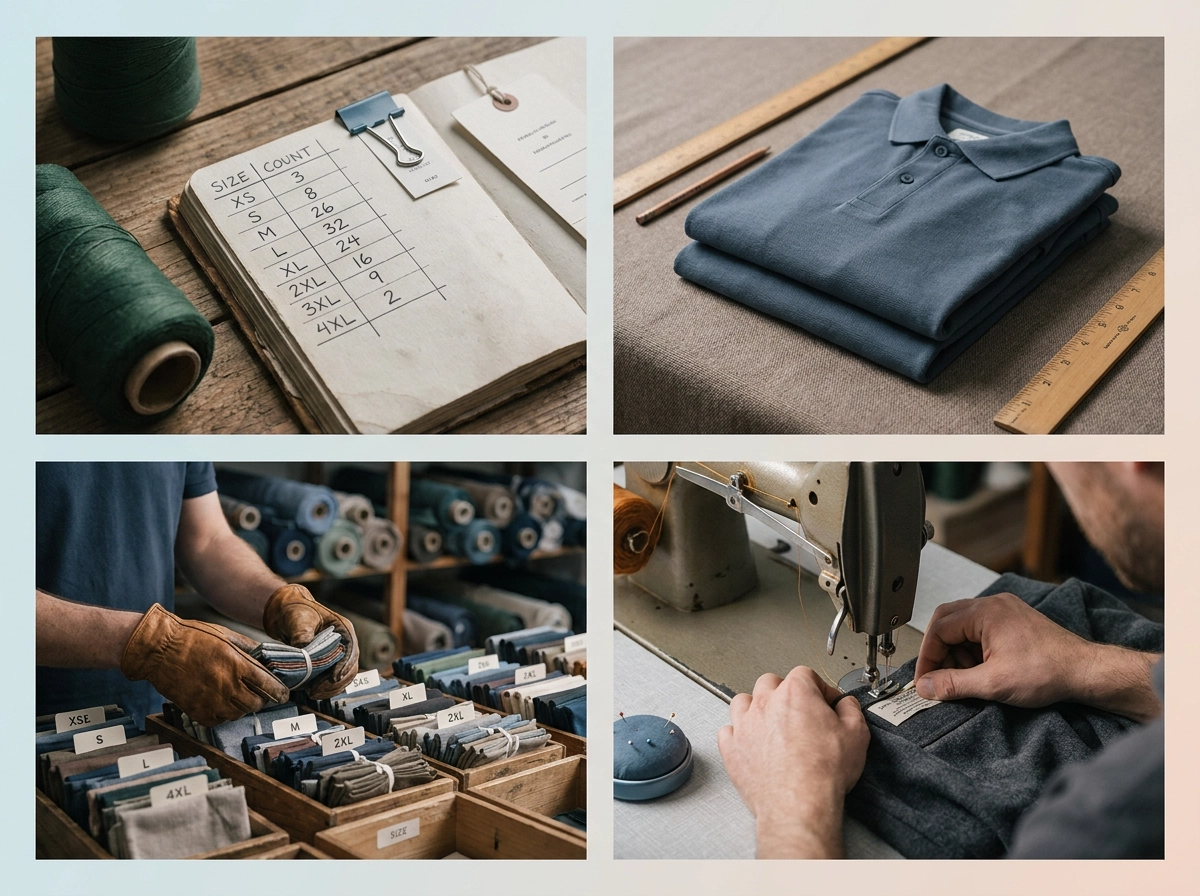
With the reserve rule set, the arithmetic becomes easier to see on a deliberately fictional 120-person roster: 3 XS, 8 S, 26 M, 32 L, 24 XL, 16 2XL, 9 3XL, and 2 4XL. It is illustrative only, not a client result.
Base order. At two polos per wearer, the roster calls for 240 units. Allocate them in the roster’s exact proportions: 6 XS, 16 S, 52 M, 64 L, 48 XL, 32 2XL, 18 3XL, and 4 4XL. The largest commitment mirrors who actually works there.
Flat-percentage failure. An even buffer abandons the tail, the arithmetic failure shown in Step 2.
Defined gap sizes. On the same roster, add one spare each in XS and 4XL, two each in L and XL, and apply a written rule for middle sizes. The targeted buffer covers the tail without inflating the order.
Held reserve. Keep one unit per size in the top four sizes, by size order XL through 4XL, as a separate line stored apart from working stock and replenished on a trigger.
The counts change with every roster; the method transfers to any size.

Where Size Runs Usually Go Wrong
Even a sound method breaks down in five familiar places. The first is treating population anthropometry as a garment size chart. The NC State Ergonomics Center tables show 5th to 95th percentile stature of 64.88 to 73.62 inches for men and 60.04 to 68.50 inches for women, useful for illustrating spread. But the page labeled U.S. Adults comes from the 2012 U.S. Army anthropometric survey (Gordon et al., 2014) and measures bodies, not shirts. It argues that one size cannot cover a workforce, not how many mediums to buy.
The second is citing a national dataset as if it predicted a specific employer. NCHS published Anthropometric Reference Data for Children and Adults covering August 2021 to August 2023 in June 2025, and a civilian probability sample will still never match one roster.
The third is reusing last year’s run unchanged after the roster shifted, a site closed, or a garment was replaced by a style with different grading. The fourth is mixing unisex and ladies cuts as though the letters were interchangeable, which manufactures the gap sizes the run was meant to cover. The fifth is locking sizing after decoration deadlines. Once screen setup or embroidery digitizing is approved, a size change becomes a schedule problem, not an order change.
The common thread is treating the forecast as a fixed document rather than one you audit.
The Size Run Is a Forecast You Can Audit
The fix is to make the method repeatable. Run the four moves in sequence: build from the current roster, add defined gap sizes instead of a flat percentage, select garments that size consistently across styles, and hold a small reserve apart from working stock. Then write the rules down, including the rounding rule, the tail policy, and the reserve trigger, so the next buyer runs the same method rather than rebuilding it from scratch.
We recommend auditing each cycle: track exchanges, replacements, and spares consumed. If one size consistently drains the reserve, adjust the rule behind it, not just the reorder quantity. That is the difference between a forecast you can defend and a guess you repeat annually.
For teams that would rather not run the forecast alone, OneStop Northwest handles branded apparel and uniform programs, embroidery and printing, and company stores as part of a single-source model, from Shelton, Washington, serving organizations across the Pacific Northwest and nationwide, with more than $2 billion in collective buying power and low or no minimums on many items.
Conclusion
At OneStop Northwest, we recommend building a uniform size run as a repeatable forecast rather than a one-time guess, using the four steps above. If you would rather not run that forecast alone, OneStop Northwest handles branded apparel and uniform programs, embroidery and printing, and company stores through a single-source model, with low or no minimums on many items. Start by pulling your current roster and last cycle’s exchange data, then build the size run you can defend.
Frequently Asked Questions
Why is overbuying considered the same failure as stranding staff?
Overbuying and stranding both trace back to forecasting poorly. Overbuying leaves capital in boxes, adds storage and handling costs, and can make styles obsolete. Stranding is the same error from the wearer's side: an employee in a gap size wears an out-of-policy or ill-fitting garment, or a new hire waits for a replacement.
What should I have in hand before placing a uniform order?
Five things: a current roster counted by site, department, and role (separating required from optional wearers); a chosen size collection method; confirmed size charts for every style under consideration; separate runs for each garment family; and a confirmed calendar covering decoration date, production window, and when the first wearer needs the garment.
Why should the size run be built from my own roster instead of national body data?
A national survey like NHANES describes the U.S. civilian population as a whole, not any one employer's workforce. Your own roster is the only defensible input for forecasting how many units each size needs, and it should include open requisitions, seasonal and per diem staff, and loaner or visitor sets.
Why use defined gap sizes instead of adding a flat percentage buffer?
A flat percentage protects high-volume sizes and abandons the tail. For example, 10% of a size with six wearers is 0.6 units, which rounds to zero or one. The post recommends a written rule instead: one spare in each extreme size the roster uses, plus one or two spares in the two highest-volume sizes, applied the same way every cycle.
What is the held reserve for new hires, and how should it be managed?
The reserve is a count, not a percentage, such as one unit per size across the top four sizes the roster uses. It should be stored physically and recorded separately from working stock, restocked on a written trigger checked on a fixed schedule, and tied to confirmed supplier lead times so it covers replacements and roster changes between order cycles.